21 August 2026

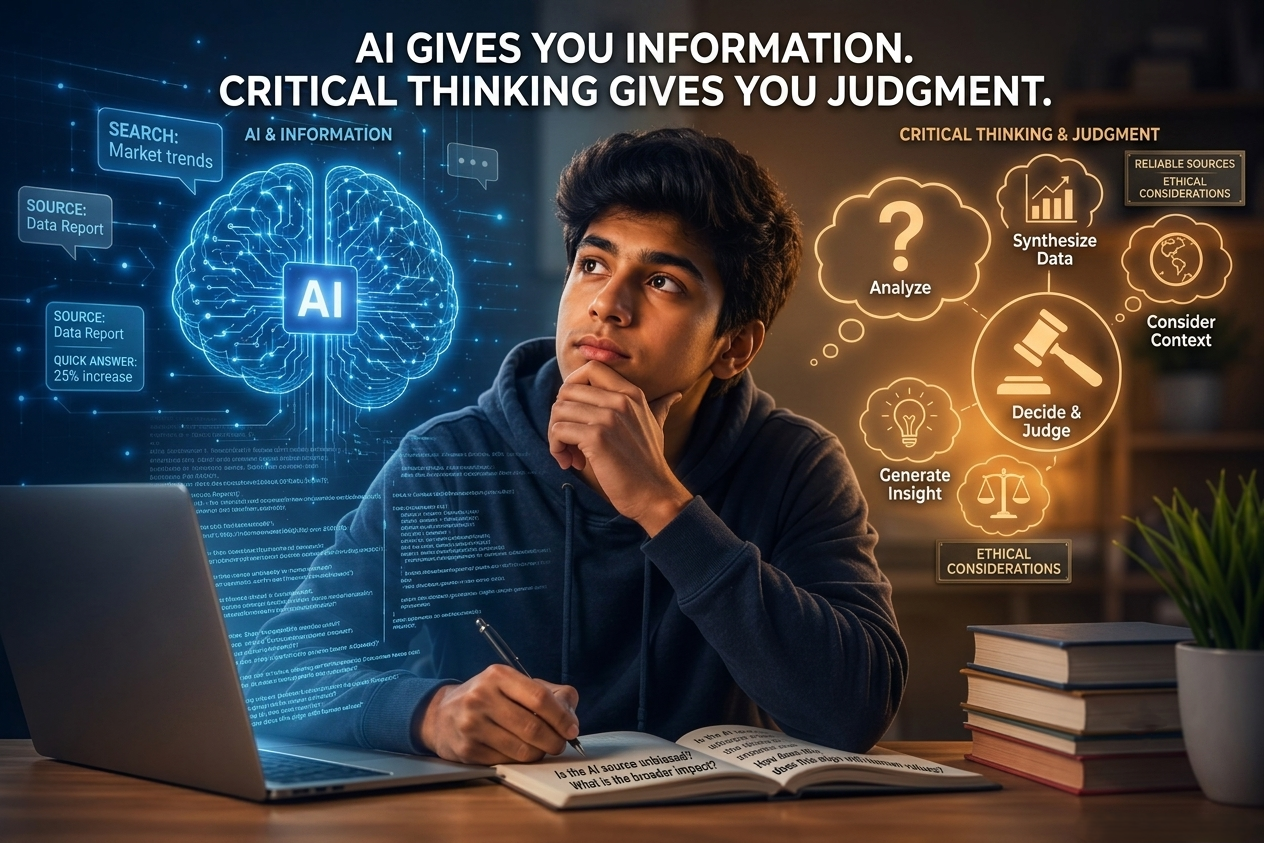
AI Gives You Information. Critical Thinking Gives You Judgment.

You ask AI a question.

Seconds later, you have an answer.

It sounds clear. It looks convincing. But there is one question you still need to ask:

“Is it actually right?”

AI has made information easier and faster to access than ever. Students can use it to understand concepts, generate ideas, solve problems, and explore new topics.

But getting an answer is not the same as understanding it.

That is why learners need more than answers they need the ability to evaluate them.

AI Can Give You an Answer. But Can You Evaluate It?

AI can provide information quickly, but it may not always provide the complete picture.

A good learner doesn't simply accept an answer because it sounds confident. They stop and ask:

  • Does this make sense?
  • What evidence supports it?
  • What might be missing?
  • Are there other viewpoints?
  • How can I apply this?

AI gives you possibilities.

Your reasoning helps you turn those possibilities into informed decisions.

AI and Critical Thinking Can Work Together

AI doesn't have to replace thinking. It can actually help strengthen it.

For example, instead of asking AI:

“Give me the answer.”

Try:

“Give me three possible solutions and explain the strengths and weaknesses of each.”

Now you're not simply receiving information. You're comparing, questioning, and making a decision.

You can also ask AI to:

  • Challenge your argument
  • Give you another perspective
  • Explain why an answer could be wrong
  • Create a problem for you to solve
  • Review your reasoning

The goal is to use AI as a learning partner, not a shortcut around thinking.

The 5 Questions Every Learner Should Ask

Before accepting an AI-generated answer, ask:

1. What is the answer actually saying?

Can you explain it in your own words?

2. What supports the answer?

Look for evidence, examples, or reasoning.

3. What could be missing?

Consider the context and information that may have been left out.

4. Are there other possibilities?

Don't stop at the first explanation.

5. How can I use this information?

Apply it to a problem, project, or real situation.

These simple questions can turn passive information consumption into active learning.

Why This Matters for Students

Students today have access to more information than ever before.

The challenge is no longer simply finding information.

It is knowing how to understand, evaluate, and use it.

Skills such as critical thinking, problem-solving, communication, creativity, and adaptability are becoming increasingly important alongside academic knowledge.

A student who can find an answer is useful.

A student who can question, improve, and apply that answer is much more prepared for the real world.

Review. Act. Reflect.

Good learning doesn't end when you get an answer.

Take a moment to:

Review – What did I learn? What is unclear?

Act – Can I apply it or solve a problem using it?

Reflect – What worked? What could I improve?

This Review–Action–Reflection approach helps turn information into understanding and understanding into better action.

AI Is the Tool. You Are Still the Thinker.

AI is changing how students learn.

The answer isn't to avoid it.

The answer is to use it intelligently.

Use AI to explore ideas.
Use it to practise.
Use it to challenge your thinking.
Use it to see different perspectives.

But don't hand over your judgment.

Because the real advantage isn't being the person who gets an AI answer fastest.

It's being the person who knows what to do with it.

Final Takeaway

AI can make learning faster.

Critical thinking makes learning meaningful.

The future-ready learner won't simply ask:

“What does AI say?”

They will ask:

“Why does this make sense?”
“What evidence supports it?”
“What might be missing?”
“How can I apply it?”

That's the difference between getting information and actually learning from it.

At YMetaconnect, AI-powered learning goes beyond simply providing information. It helps learners build better thinking, problem-solving, reflection, and self-regulated learning habits so they can learn with technology while continuing to think for themselves.

Because AI can give you information.
But learning to use it wisely is a skill of its own.


Frequently Asked Questions

No. AI can provide information, ideas, and possible solutions, but learners still need to evaluate information, question assumptions, and make their own decisions.

Use AI to explain concepts, explore different perspectives, practice problems, and receive feedback. Instead of asking AI to do everything, use it to support your own thinking and learning.

AI-generated information can sometimes be incomplete or inaccurate. Critical thinking helps students question information, evaluate evidence, consider alternatives, and decide whether an answer is reliable.

Ask whether the information makes sense, what evidence supports it, what might be missing, whether other viewpoints exist, and how you can apply the information.

AI can help learners explore concepts, practise, receive feedback, identify areas that need improvement, and approach topics in different ways. When combined with active thinking and reflection, it can become a useful learning partner.