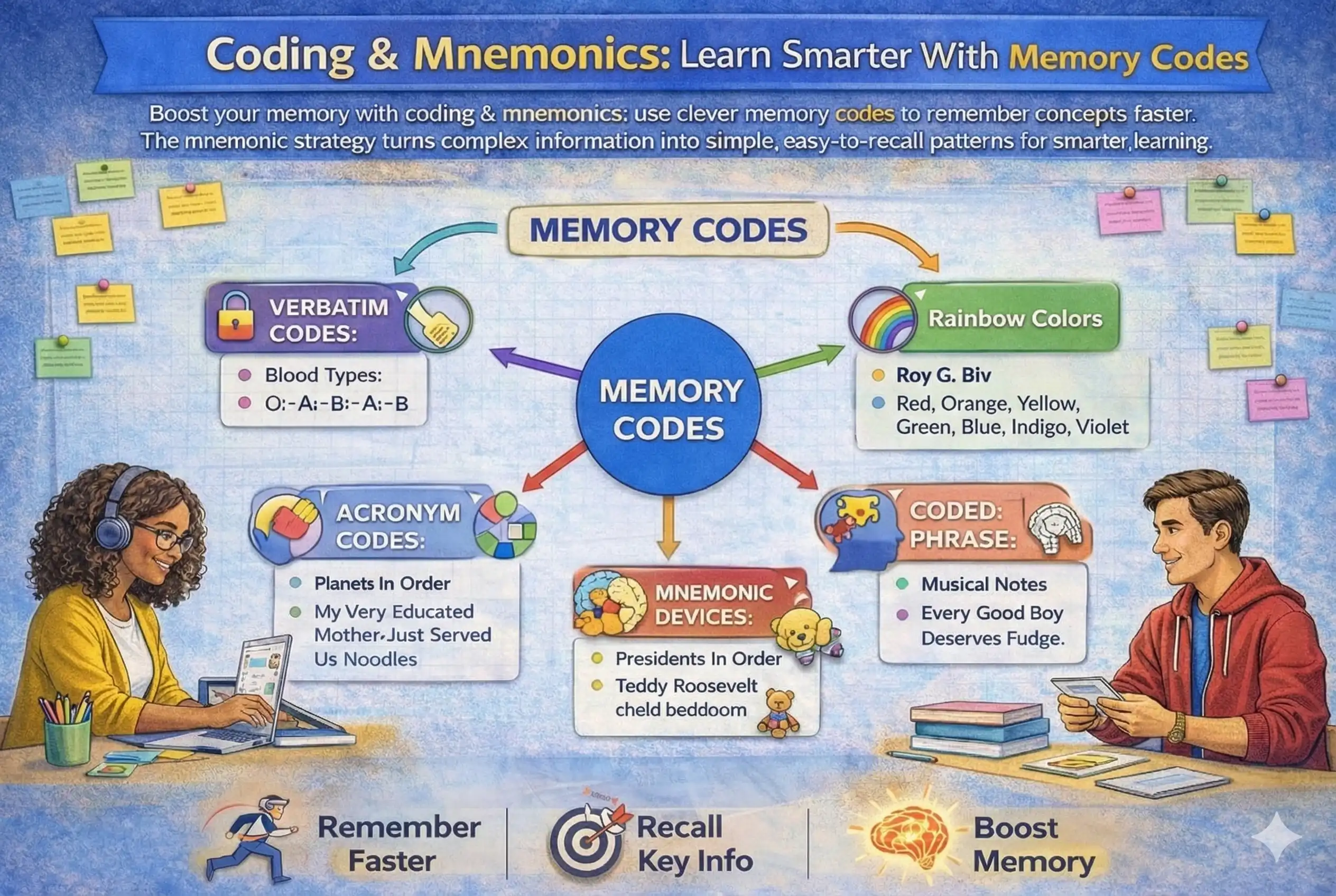
Coding & Mnemonics:
Learn Smarter With Memory Codes

Boost your memory with coding & mnemonics; use clever memory codes to remember concepts faster. The mnemonic strategy turns complex information into simple, easy-to-recall patterns for smarter, quicker learning.

Try for Free

What Is the Coding & Mnemonics
Method?

Coding and mnemonics are a smart learning approach that helps learners remember complex information quickly. Instead of memorizing long lists or difficult details word for word, learners use acronyms, short codes, rhymes, or creative phrases to make information stick. This method fits naturally into the types of mnemonic strategies and is used in subjects that need strong recall.

Try for Free

How Coding & Mnemonics Boosts Learning?

Coding and mnemonics may look simple, but they are powerful tools for long-term memory. Here are the key benefits:

Boosts Memory Power

This method strengthens memory by building strong associations. Instead of storing raw information, learners remember patterns, phrases, or a single code that triggers the full concept.

Simplifies Complex Details

Long sequences, definitions, or formulas become easier when broken down into short mnemonic codes. This reduces stress and builds confidence while studying.

Quick Recall in Exams

Mnemonics work like instant triggers. During exams or presentations, one code or phrase helps learners recall the full explanation quickly.

Encourages Creativity

Creating mnemonic strategies for memory is enjoyable. When learners build their own cues, they use imagination, humor, or personal connections, making the learning process engaging.

Reduces Cognitive Load

Mnemonics group information into small, digestible units. This prevents overload and helps the brain store information more efficiently.

Works Beyond Academics

Coding mnemonics aren’t limited to textbooks. Professionals use them for remembering steps, procedures, safety rules, or technical processes in daily work.

How Does the Coding & Mnemonics Method Works?

Coding and mnemonics work by turning lengthy information into short, memorable cues. Here’s how the method works:

  • Identify Important Information

    Choose the facts, rules, or sequences you need to remember.

  • Create a Short Code

    Convert the information into initials, a phrase, a rhyme, or a simple mnemonic code.

  • Add Meaning or Imagination

    Build a story, picture, or funny line. The stronger the connection, the easier it is to recall.

  • Practice Using the Mnemonic

    Use the mnemonic while recalling notes, solving problems, or answering questions.

  • Refine and Improve

    If the mnemonic feels confusing or long, simplify it. Good mnemonics should be short, clear, and memorable.

How YMetaconnect Enhances This Learning Method

YMetaconnect helps learners use coding and mnemonics effectively through guided tools and practice opportunities. Here’s how YMetaconnect supports this method:

  • Method Selection by RAR AI

    When content that requires memorization is uploaded, YMetaconnect’s RAR AI reviews it along with learner inputs. Based on content type, difficulty level, learning style, and language proficiency, the platform selects coding and mnemonics as the most suitable method.

  • Automatic Mnemonic Creation

    Once the method is selected, RAR AI analyzes the content and suggests memory aids such as abbreviations, symbols, keywords, or mnemonic devices to make recall easier.

  • Understanding the Method Choice

    Along with the memory aids, RAR AI explains why coding and mnemonics were chosen for that content. This helps learners understand when this strategy works best and how it supports memory.

  • Applying Memory Aids

    The generated codes and mnemonics act as a foundation for individual and group activities such as quizzes, flashcards, and recall exercises.

  • Reflection for Better Retention

    Finally, AI encourages learners to reflect on how they used coding and mnemonics and identify ways to improve long-term retention and recall.

Fequently asked questions

They should pick key points, turn them into short patterns or phrases, add meaning, and practice recalling them regularly.

Absolutely. Many programmers use mnemonic strategies to remember commands, steps, logic rules, or shortcuts.

Yes. Mnemonics help students recall rules, formulas, and lists instantly during exam pressure.

No. Mnemonics also improve understanding by creating meaningful connections between new and familiar ideas.

Their purpose is to simplify complex information into short, memorable codes so learners can recall it easily.

Our Latest Blog

View all

Mind Map Ideas for Students to Support Creative Thinking and Better Memory

Learning can be confusing when there are a lot of notes that are difficult to remember. Many students will read the same page over and...

YMetaconnect

05 Feb 2026
Read More

Growth vs Development in Children: What’s the Real Difference?

The terms "growth" and "development" are often used together. Many parents believe that these terms are the same thing. They are not. Growth and development...

YMetaconnect

05 Feb 2026
Read More

Personality Development: Meaning, Types, and Key Factors

Why do two people act differently in the same situation? The answer to this question is often found in the development of personality. Personality affects...

YMetaconnect

05 Feb 2026
Read More

Co-Education in Schools: Positive and Negative Effects on Students

Have you ever wondered how learning alongside both boys and girls impacts students? Co-education is a common system in schools worldwide, but it comes with...

YMetaconnect

05 Feb 2026
Read More