Break It Down, Remember It All:
The Power of Passage Mapping

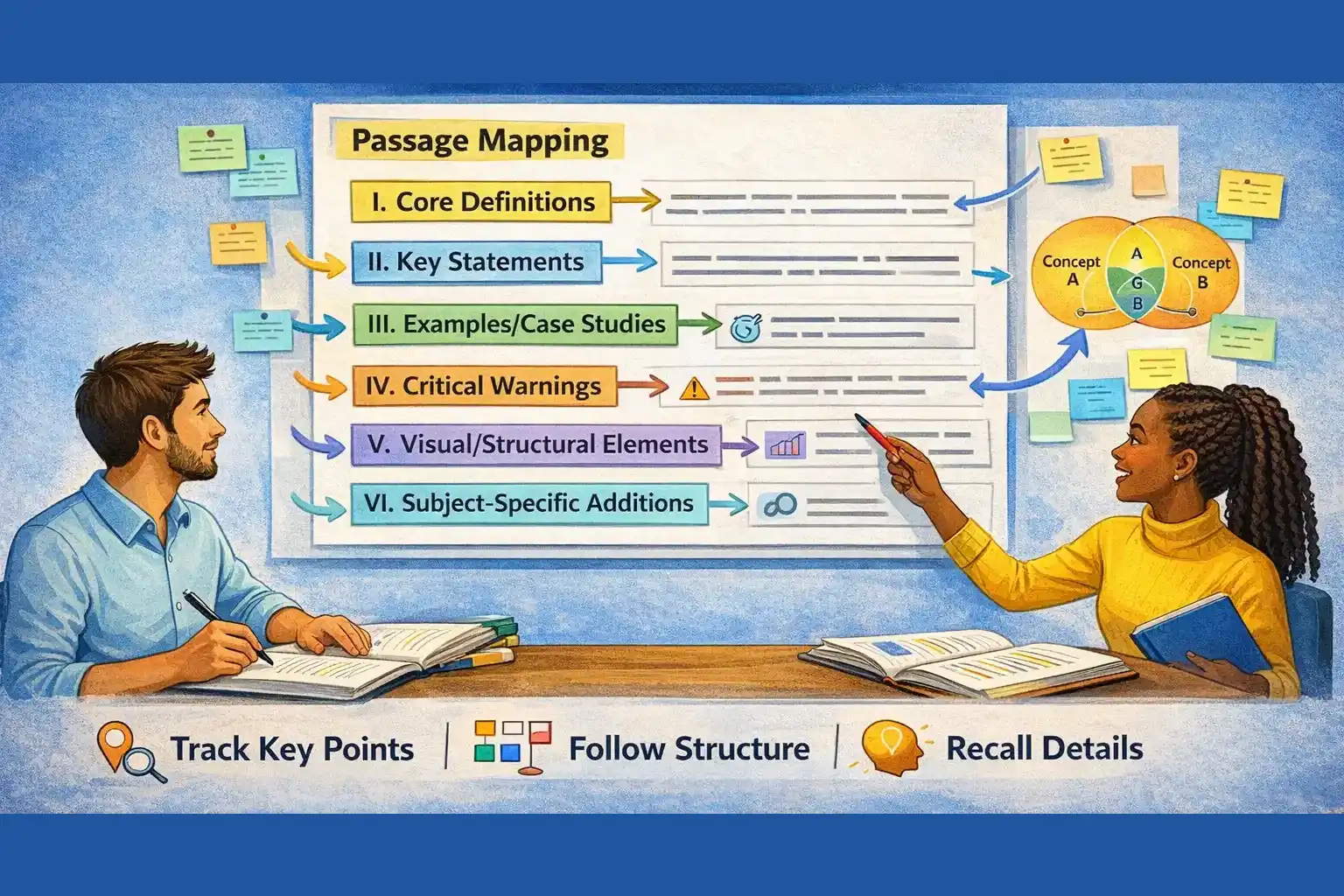
Break content into meaningful sections to see how ideas connect and flow. Passage mapping helps learners track key points, follow structure, and recall information with ease. Learning becomes clearer, more focused, and easier.

Try for Free

What Is the Passage Mapping Method?

The passage mapping method helps learners break long texts into smaller, meaningful parts so they can understand ideas clearly. It involves marking key points, highlighting connections, and visually organizing the flow of information. It strengthens text mapping skills by turning dense paragraphs into easy-to-follow chunks and works well when studying literature, passages, essays, etc.

Try for Free

How Does Passage Mapping Boost Learning?

Passage mapping makes reading more focused and helps students understand complex texts with confidence. Key benefits include:

Clear Understanding of the Passage

Breaking the text into smaller segments makes it easier to grasp ideas without feeling lost in long paragraphs.

Improves Focus and Attention

Mapping highlights central points, transitions, and supporting details, ensuring the reader stays attentive throughout the passage.

Enhances Memory and Recall

Visual markers, notes, and labels help the brain organize information logically, improving recall during exams.

Strengthens Critical Reading Skills

Learners identify arguments, tone, examples, and evidence, building stronger reasoning and interpretation abilities through effective passage analysis.

Builds Confidence in Exams

Passage mapping trains learners to read faster, understand better, and answer questions more accurately.

Encourages Active Engagement

By using text mapping, underlining, labeling, and summarizing, learners stay actively involved in reading, which deepens comprehension and makes studying more meaningful.

How Does the Passage Mapping Method Works?

The passage mapping method breaks text into a structured flow to improve understanding and retention. Here’s how it works:

  • Read the Passage Once

    Read the full text to get a general idea of the topic, flow, and main message.

  • Divide the Passage into Sections

    Break the passage into small chunks or paragraphs. Mark where new ideas, examples, or shifts appear.

  • Highlight Key Points

    Underline the main ideas, important arguments, examples, and definitions to make the structure visible.

  • Add Notes and Labels

    Write short notes in the margins—such as “main idea,” “example,” “contrast,” or “conclusion.” This clarifies the text instantly.

  • Create a Visual Flow

    Draw arrows, circles, or small boxes to show connections between ideas. This moves passage mapping into a visual format.

  • Review and Simplify

    Check your mapped passage for missing points or extra markings. Clean it up so it becomes a clear study tool.

How YMetaconnect Enhance This Learning Method?

YMetaconnect makes passage mapping easier, more interactive, and simpler to revise. Here’s how the platform supports this method:

  • Method Selection by RAR AI

    When a learner uploads a text, YMetaconnect’s RAR AI reviews the content along with the learner's inputs. Based on the content type, learning style, difficulty level, and language proficiency, it selects passage mapping as the most suitable text-mapping learning method.

  • Automatic Passage Mapping

    Once the method is selected, RAR AI analyzes the text in detail. It identifies the main idea, purpose, structure, and key arguments, then organizes them into a clear passage map.

  • Understanding the Method Choice

    Along with the passage map, the RAR AI explains why this method was chosen for the specific text. This helps learners understand when passage mapping is useful and how it supports deeper comprehension.

  • Applying the Passage Map

    The generated passage map serves as a strong foundation for individual and group activities such as debates, discussions, and critical thinking exercises.

  • Reflection for Better Comprehension

    The AI encourages learners to reflect on how they mapped the passage. This reflection helps improve comprehension, analysis, and overall reading strategies.

Fequently asked questions

Yes, beginners can use mapping easily. Even new learners can follow simple steps, divide, highlight, label, and review to understand passages clearly.

Mapping improves comprehension by breaking down the text into small parts. Mapping highlights the flow and makes ideas easier to follow.

Yes, passage mapping works for non-academic reading. It can be applied to news articles, reports, or professional documents.

Absolutely. Passage mapping can be used for literature, as it helps analyze themes, tone, character actions, and the writer's intent.

Yes. Passage mapping helps students read faster, understand better, and answer questions more accurately.

Our Latest Blog

View all

What are the Benefits of the Internet for Students?

The internet has changed how students learn, think, and grow. Learning is no longer limited to classrooms or textbooks. With a phone or computer, students...

Read More

What Are the Key Benefits of Learning English?

English is more than just a subject taught in school. It is a life skill that opens doors in education, work, and daily communication. From...

Read More

What Does Curriculum Mean in Education? Types, Purpose, and Impact

Education does not happen by chance. Behind every lesson, activity, and assessment, there is a clear plan. That plan is called the education curriculum. It...

Read More

10 Powerful Benefits of Reading Books for Knowledge and Personal Growth

The impact of books on our lives is a major one. Books do not raise their voices to attract attention, but they always leave a...

Read More

What are the Benefits of the Internet for Students?

The internet has changed how students learn, think, and grow. Learning is no longer limited to classrooms or textbooks. With a phone or computer, students...

YMetaconnect

28 Jan 2026
Read More

What Are the Key Benefits of Learning English?

English is more than just a subject taught in school. It is a life skill that opens doors in education, work, and daily communication. From...

YMetaconnect

28 Jan 2026
Read More

What Does Curriculum Mean in Education? Types, Purpose, and Impact

Education does not happen by chance. Behind every lesson, activity, and assessment, there is a clear plan. That plan is called the education curriculum. It...

YMetaconnect

28 Jan 2026
Read More

10 Powerful Benefits of Reading Books for Knowledge and Personal Growth

The impact of books on our lives is a major one. Books do not raise their voices to attract attention, but they always leave a...

YMetaconnect

28 Jan 2026
Read More