23 December 2025
Ancient Education System Vs Modern Education System
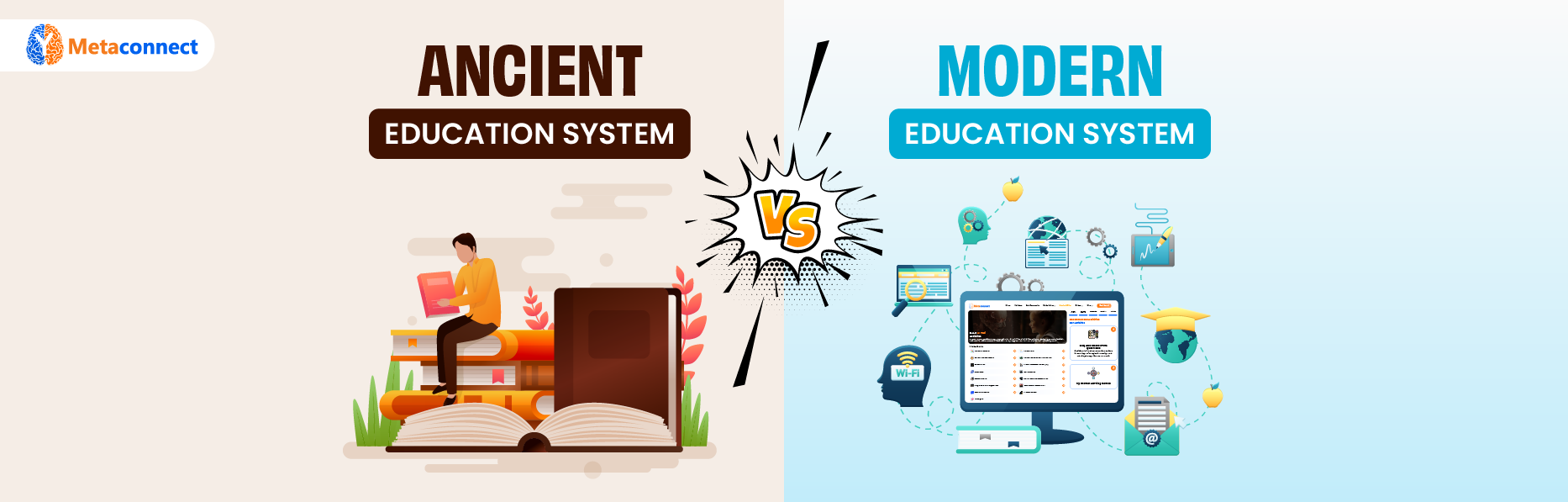
Education is the major factor that influences a person’s way of thinking, behavior, and life. From the oldest times to the present day, the ways of learning have changed.
Previously, education was more about values, discipline, and skills for daily life. Now, education is more about subjects, exams, and careers. Both ancient and modern education were designed to help students, but they work very differently. Knowing the differences helps students to understand past and present learning.
This guide clarifies both education systems, key comparisons between modern education vs traditional education, and which method works better. Let’s understand in more detail.
What Was the Ancient Education System?
The ancient education system was based on the close relationship between the teacher and the student. Students stayed with the teacher in gurukuls or at the teacher’s home and received their instruction there. Education was integrated into the daily routine and was not limited to a specific place or time.
People learned by listening, observing, discussing, and performing real-life tasks. In this system, learning valued understanding over memorisation versus understanding, so students moved forward only after fully grasping each lesson. Teachers were committed to discipline, morals, control of oneself, and taking responsibility. Education was given through stories and examples. There were no tests or marks. Students learned in their own way until they mastered each lesson.
The primary purpose was to develop strong character along with knowledge.
What Is Modern Education System?
The modern education system follows a planned and orderly method of teaching. First, students attend schools and colleges where learning is divided into classes, subjects, and time periods. Each year, a fixed syllabus guides what students are expected to learn, keeping in mind modern learner needs.
Learning takes place through textbooks, written notes, classroom lectures, and technology-based tools. At the same time, teachers manage a large number of students together. Student progress is measured through tests, marks, and certificates. In many cases, exam performance decides future education options and career choices.
Overall, modern teaching methods prepare students for higher studies, professional courses, and jobs in the working world.
Key Differences Between Ancient and Modern Education Systems
Both systems differ in their methods, goals, and learning environment. Ancient learning focused on personal growth and values. Modern learning focuses on academic achievement and career preparation.
The table below illustrates the difference between ancient education and modern education.
|
Aspect
|
Ancient Education System
|
Modern Education System
|
|
Learning place
|
Gurukuls, the teacher’s home, and nature.
|
Schools, colleges, and classrooms.
|
|
Teacher role
|
Mentor and life guide.
|
Subject instructor.
|
|
Student-teacher bond
|
Very close and personal.
|
Limited due to large classes.
|
|
Learning method
|
Oral teaching, discussion, and practice.
|
Books, lectures, and digital tools.
|
|
Subjects taught
|
Values, discipline, life skills.
|
Academic and technical subjects.
|
|
Learning pace
|
Flexible.
|
Fixed timetable.
|
|
Evaluation method
|
Observation-based.
|
Exams and grades.
|
|
Focus of education
|
Character and wisdom.
|
Career and academic success.
|
|
Learning environment
|
Calm and peaceful.
|
Structured and busy.
|
|
Use of technology
|
Not used.
|
Widely used.
|
|
Competition
|
Very low.
|
High competition.
|
|
Stress level
|
Low learning pressure.
|
High exam pressure.
|
|
Skill development
|
Life skills
|
Job and technical skills
|
|
Access to education
|
Limited access
|
Education for many
|
|
Certification
|
No formal degrees
|
Degrees and certificates
|
From the table, it is clear that when we compare ancient education vs modern education, the ancient education system emphasized the development of good moral values, discipline, and personal growth. The education system was based on gurukuls, where the teacher closely guided the students, and the pace of learning was flexible. Modern education is more subject-focused and grades-oriented. Learning is done in schools, which have a fixed schedule and exams and utilize digital tools.
The old education system was aimed at building character and imparting wisdom. The modern education system builds professional and technical skills. Both systems fulfill different requirements. While ancient education adapted to each learner naturally, modern classrooms often attempt student-centred learning by encouraging participation, projects, and independent thinking, though time and class size can limit this approach.
Advantages and Limitations of Both Education Systems
Both education systems have their pros and cons. Let’s look at each one by one.
1. Advantages and Disadvantages of Ancient Learning
Some common benefits of the ancient education system include:
-
Builds strong moral values and discipline.
-
Offers personal attention through close teacher guidance.
-
Encourages deep understanding through daily practice.
-
Promotes calm thinking and self-control.
-
Connects learning with real-life experience.
Some common drawbacks of the ancient education system include:
-
Limited subject choices and learning areas.
-
Knowledge spreads slowly due to oral teaching.
-
Lacks formal certificates for careers.
-
Education access is limited to a few learners.
2. Advantages and Disadvantages of Modern Learning
Some common benefits of the modern education system include:
-
Provides access to many subjects and fields.
-
Prepares students for careers and higher studies.
-
Uses technology to support learning.
-
Follows a clear system for evaluation.
-
Reaches a large number of students.
Some common drawbacks of the modern education system include:
-
Creates pressure due to exams and competition.
-
Offers limited personal attention to students.
-
Focuses more on marks than understanding.
-
Gives less importance to life skills and values.
Which Education System Is More Effective Today?
The modern education system is more suitable for career requirements in today's world. Most positions require a degree and technical skills. Schools and colleges offer structured learning and make opportunities available equally to all.
However, several students struggle with stress and lack of concentration. Discipline, patience, and strong moral values are some of the things that are taught in the old education system.
Students will be able to have academic as well as life success if a blended method, which combines modern skill development with ancient values, is used.
Conclusion
Education has changed with time, but its purpose remains the same. Ancient education taught students how to live with discipline, values, and wisdom. Modern education teaches students how to succeed in academics and careers. Each system has strengths and weaknesses.
Ancient learning shaped character. Modern learning builds skills for the future. When both approaches are combined, education becomes more meaningful. A balanced education system helps students grow into responsible, skilled, and thoughtful individuals who are ready for both life and work.



 Jumpstart Journal
 R-A-R Activity
 Critical Thinking Exercise
 Picture Reflection Or Photo Caption
 Presentation
 Thematic Apperception Test (TAT)
 Flash Card
 Micro Learning
 Research Skills
 Workshop Report Presentation
 MCQ And Descriptive Questions
 Video Analysis Presentation
 Scenario Planning
 Problem Solving
 Trivia Quiz
 Flipped Classroom
 Generative Knowledge Interviewing
 Think-Pair-Share
 Fish Bowl Group Activity
 Jigsaw Method
 Simulation
 Peer Interview
 Role Play
 Debate
 Group Discussion
 Futurism And Trend Analysis
 Report Presentation
 Assignment Presentation
 Research Article Review Presentation
 Peer Teaching
 Industrial Visit Report Presentation
 Video Podcast
 Games
Games
 Business Games
 Collaborative Project
 Team Building
 Role Reversal
 Leadership Activity
 Pitch Deck
 Case Analysis Presentation


 Learner
 Mentor
 Organisation
 Learner
 Mentor
 Organisation