12 May 2026
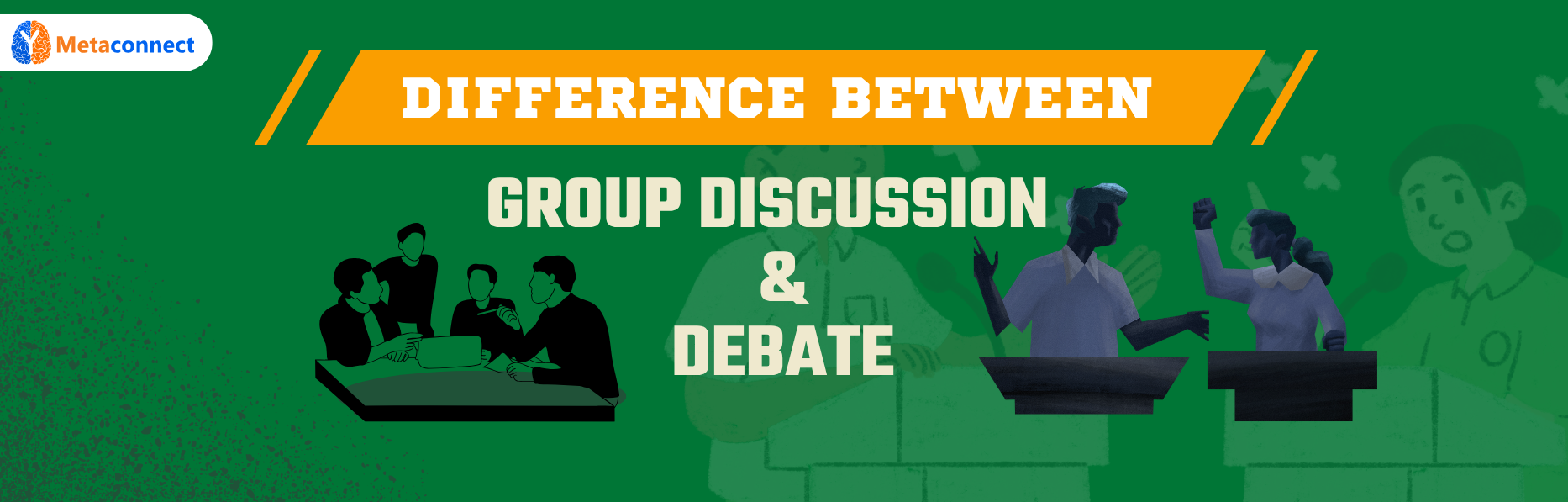
Difference Between Group Discussion and Debate
Have you ever noticed what happens during a group discussion or debate in an interview room or classroom?
Firstly, everything seems familiar. Discussions happen; people agree with some things, disagree with others, and talk just a little at a time.
But then something else happens a few minutes into the discussion. In one case, there is a good flow of discussion. People listen, think, and help each other out for clarity.
In the other case, the atmosphere turns aggressive. The two sides take opposing views, debate becomes heated, and everyone tries to make out why their view is correct.
Group debate involves public speaking; both require ideas, and both consist of discussions. But the difference between group discussion and debate is totally different.
This is the major misconception many candidates have about these skills, which is why many fail at them. Let’s make it clear and practical by understanding the major difference between group discussion and debate.
What is a Group Discussion?
Group discussion refers to a carefully organized discussion among a few people wherein they exchange views and thoughts on a particular topic for learning and clarification.
The primary aim is not to win or beat anyone but to listen to different viewpoints and gain knowledge from the discussion, and this pretty much explains group discussion.
In other words, rather than being critical of others, you are talking and collaborating with them.
This explains why group discussions are commonly employed in schools, colleges, and interviews, because group discussion in communication measures your ability to interact and think logically in a group.
What Defines a Group Discussion?
A group discussion typically has these features:
- Free-flowing conversation without strict sides.
- Equal opportunity for participants to speak.
- Focus on clarity rather than argument.
- Active listening and meaningful response.
- A cooperative rather than competitive environment.
But beyond these features, what truly matters is the purpose behind it.
Purpose of Group Discussion
The purpose of group discussion & group activities lies in helping you with the following:
- Expressing your ideas clearly.
- Developing confidence in group speaking.
- Improving listening and response skills.
- Understanding different viewpoints.
- Building logical thinking through collaboration.
In short, it helps you think along with others, not against them.
What is a Debate?
Now, let us move on to something totally different, structurally and purposefully; that is, a debate.
A debate is an organized discussion in which the people involved are grouped into two sides, one favoring the subject matter and the other rejecting it.
They present their arguments and defend their positions while attacking the position of the other side.
In contrast with a group discussion, the aim of a debate is not to reach an agreement, but rather it aims to persuade.
What Defines a Debate?
A debate usually has the following:
- Two clearly opposing sides.
- Fixed structure and speaking turns.
- Time limits for each speaker.
- Strong focus on logic and evidence.
- A competitive and persuasive environment.
Every statement is made with the intention of strengthening your side’s position.
Purpose of Debate
Debates help you:
- Build strong and structured arguments.
- Think quickly under pressure.
- Defend your ideas confidently.
- Respond effectively to opposition.
- Improve persuasive communication skills.
So while group discussion builds understanding, debate builds argument strength and confidence.
Key Difference Between Group Discussion and Debate
Both are forms of oral communication in which participants share their views about an issue that they have in common. Yet, there is a vast difference between group discussion and debate.
While group discussions emphasize idea-sharing, debates emphasize persuading others.
Below is a clear comparison:
|
Aspect
|
Group Discussion
|
Debate
|
|
Meaning
|
A discussion where people freely share ideas to understand a topic better.
|
A structured discussion where two sides argue for and against a topic.
|
|
Goal
|
To gain clarity and explore different viewpoints.
|
To convince others that one side is correct.
|
|
Nature
|
Cooperative and discussion-based.
|
Competitive and argument-based.
|
|
Structure
|
Informal and flexible flow of conversation.
|
Formal structure with fixed speaking turns.
|
|
Approach
|
Participants build on each other’s ideas
|
Participants challenge and oppose ideas.
|
|
Interaction Style
|
Focus on listening, sharing, and responding.
|
Focus on arguing, defending, and countering.
|
|
Tone
|
Calm, respectful, and balanced.
|
Strong, confident, and assertive.
|
|
Outcome
|
Better understanding of the topic.
|
One side is considered more convincing.
|
This shows clearly that the same topic can be handled in completely different ways depending on the format.
How Does the Difference Between Group Discussion and Debate Work in Real Life?
Take a simple topic such as:
Should social media be limited for students?
In a group discussion, participants will:
- Share different opinions.
- Listen to others carefully.
- Add relevant points based on the discussion.
- Try to reach a balanced understanding.
In a debate, participants will:
- Take a clear position for or against.
- Prepare strong arguments.
- Challenge the opposite side.
- Focus on proving their side correct.
The topic is the same, but the approach changes completely.
Common Mistakes Students Make
Many students mix up these two formats.
Some argue aggressively in a group discussion as if it were a debate. Others speak casually in a debate as if it were only a discussion.
This creates problems such as the following:
- Interrupting others unnecessarily.
- Lack of clarity in communication.
- Weak structure in responses.
- Poor evaluation in interviews or exams.
Understanding the correct format helps you adjust your communication style accordingly.
When to Use Each Format?
Both group discussion and debate are useful. The key is knowing when to use them.
Use Group Discussion when:
- The goal is to explore ideas.
- Teamwork and collaboration are important.
- Multiple viewpoints are needed.
- The focus is on problem-solving.
Use Debate when:
- You need to defend a clear position.
- Logical strength is being tested.
- The environment is competitive.
- The aim is to persuade others.
Conclusion
Initially, discussion and debate seem very similar, as both include talking within a group.
The difference between group discussion and debate becomes apparent once you understand their purpose.
The objectives of group discussion are all about developing mutual understanding based on shared concepts.
Debate, on the other hand, is aimed at persuading others with well-structured arguments.
Once you grasp this distinction, you will be able to communicate effectively by knowing when to speak up and when to hold back.



 Jumpstart Journal
 R-A-R Activity
 Critical Thinking Exercise
 Picture Reflection Or Photo Caption
 Presentation
 Thematic Apperception Test (TAT)
 Flash Card
 Micro Learning
 Research Skills
 Workshop Report Presentation
 MCQ And Descriptive Questions
 Video Analysis Presentation
 Scenario Planning
 Problem Solving
 Trivia Quiz
 Flipped Classroom
 Generative Knowledge Interviewing
 Think-Pair-Share
 Fish Bowl Group Activity
 Jigsaw Method
 Simulation
 Peer Interview
 Role Play
 Debate
 Group Discussion
 Futurism And Trend Analysis
 Report Presentation
 Assignment Presentation
 Research Article Review Presentation
 Peer Teaching
 Industrial Visit Report Presentation
 Video Podcast
 Games
Games
 Business Games
 Collaborative Project
 Team Building
 Role Reversal
 Leadership Activity
 Pitch Deck
 Case Analysis Presentation


 Learner
 Mentor
 Organisation
 Learner
 Mentor
 Organisation