28 January 2026
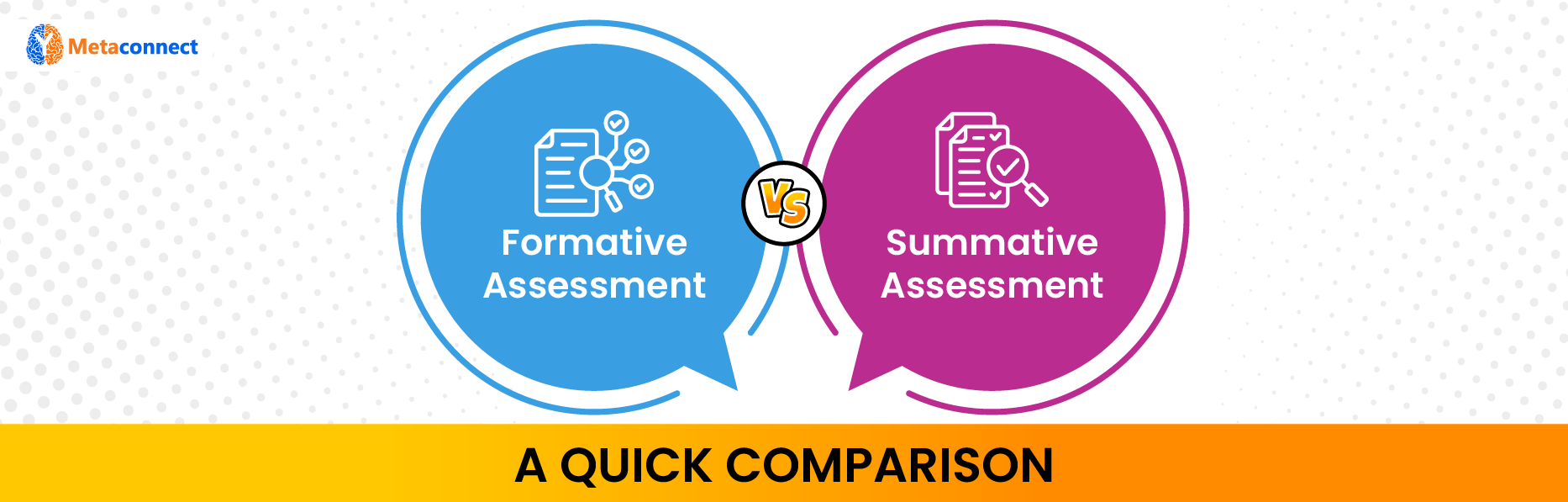
Formative Assessment vs Summative Assessment: A Quick Comparison
Assessment is an important aspect of learning. It enables teachers to assess students' performance levels and guide improvements. There are two types of assessments: formative and summative. Even though both assessments are meant for evaluating learning, they are different in terms of objectives, and their timing differs.
Formative assessment occurs during the process of learning. The main objective of formative assessment is to provide feedback. Summative assessment is done at the end of the learning process. The objective of summative assessment is to find out what has been achieved.
Understanding the difference between formative and summative helps educators plan lessons effectively, improve student outcomes, and provide accurate insights into progress.
This guide explains formative summative evaluation and the major comparison between both. Let’s dive deeper into it.
What is Formative Assessment?
Formative assessment is an ongoing evaluation that occurs while learning is happening. The primary purpose is to determine the strengths, weaknesses, and areas for improvement. Teachers use it to adjust lessons and provide feedback that helps students grow. It works best when aligned with effective learning methods that support assessment.
Examples include quizzes, class discussions, observation, homework checks, and peer reviews. Formative assessment emphasizes learning processes rather than outcomes. It helps students to reflect on their learning and improve it.
What is Summative Assessment?
Summative assessment measures student learning at the end of a unit, term, or course. The aim is to assess if the students have achieved the learning outcomes. It is a summary of what the students have learned. Teachers use summative assessment to track student progress and make decisions about grades or promotion. At this stage, students are expected to focus on organizing responses for assessment so their understanding is presented clearly and logically
Examples of summative assessments include final exams, end-of-term projects, standardized tests, and major presentations. It is often accompanied by a grade or a score that goes towards the overall performance.
Difference between Formative Assessment vs Summative Assessment
Understanding the difference between these two types of assessment helps teachers design lessons that support learning while accurately measuring outcomes.
The table below shows the difference between formative and summative assessment. Let’s have a closer look at it.
|
Feature
|
Formative Assessment
|
Summative Assessment
|
|
Purpose
|
To monitor learning and provide feedback.
|
To evaluate learning at the end of a period.
|
|
Timing
|
During the learning process.
|
At the end of a unit, term, or course.
|
|
Frequency
|
Frequent and ongoing.
|
Occasionally, usually one per unit or term.
|
|
Feedback
|
Immediate and constructive.
|
Often final with limited feedback.
|
|
Focus
|
Learning process and improvement.
|
Learning outcomes and achievement.
|
|
Examples
|
Quizzes, class discussions, and observations.
|
Final exams, projects, and standardized tests.
|
|
Stakes
|
Low stakes, no major impact on grades.
|
High stakes affect grades or advancement.
|
|
Teacher Role
|
Guides and supports.
|
Evaluates and reports.
|
|
Student Role
|
Engages, reflects, and improves.
|
Demonstrates understanding.
|
|
Flexibility
|
Adaptive, can be changed.
|
Fixed, standardized format.
|
From the above table, it is clear that in formative vs summative evaluation, formative assessment is like a coach guiding a player during practice. It focuses on progress, skill-building, and adjustments. While summative assessment is like the final match or performance, where skills are tested, and results are recorded.
Both are effective learning methods for students. Formative assessment informs learning, helping students fix gaps early. Summative assessment confirms mastery and shows what students have achieved.
Together, they offer a complete view of learning. The use of one without the other will limit insight. Teachers who use both can improve understanding and increase student confidence.
Also, educators often rely on different testing methods used in assessments to understand how students respond during the learning process and adjust instruction accordingly.
When to Use Formative vs Summative Assessment?
Knowing the right type of assessment at the right time enhances lesson planning and student performance. Formative and summative assessments have different applications, and the choice of which one to use depends on the time and objectives.
Let’s understand when to use each type of assessment.
➢ Best Times to Use Formative Assessment
Here’s when formative assessment works best to support learning at each stage.
-
During lessons, to check understanding – Confirms students are following the lesson before moving forward.
-
To give immediate feedback and correct mistakes – Enables quick feedback and correction during learning.
-
When introducing new concepts – Reveals how well students understand ideas from the beginning.
-
For skill development and practice – Encourages steady improvement through guided practice.
-
To guide learning strategies – Supports changes in teaching based on learner needs.
-
During group activities or discussions – Evaluates teamwork, participation, and idea sharing.
-
To encourage self-reflection – Builds awareness of progress and learning gaps.
-
To adapt teaching methods as needed – Indicates when content needs revision or reteaching.
➢ Best Times to Use Summative Assessment
Here are key situations where it is used to evaluate overall learning outcomes.
-
At the end of a topic or unit – Measures learning after instruction is fully completed.
-
To measure achievement against learning goals – Checks how well learners meet expected outcomes.
-
For final grades or performance evaluation – Supports official grading and performance decisions.
-
During major projects or presentations – Evaluates final work and overall subject understanding.
-
To standardize results across a class – Maintains fairness and consistency in assessment.
-
For school reports or transcripts – Records academic achievement for formal documentation.
-
When reporting to parents or stakeholders – Shares clear results and learning outcomes.
-
To evaluate overall progress over time – Reviews long-term academic growth and performance.
Choosing the right assessment type ensures students get feedback when it matters and are fairly evaluated at the end. To make both assessments more meaningful, teachers can use strategies that help students organize and connect ideas. For example, mapping concepts during learning allows students to visually link information, which enhances understanding and retention.
Final Thoughts
Formative assessment and summative assessment are both important components of the educational process. Formative assessment is used to check learning and provide immediate feedback to the students.
Summative assessment is used to measure the outcomes of learning and determine the final grades of the students. Teachers who are aware of the differences between these two assessments can use them effectively to check the learning of the students.
Combining these assessments creates a complete picture of student performance, encourages reflection, and improves learning strategies. Using these assessments effectively can result in confident students and accurate assessments



 Jumpstart Journal
 R-A-R Activity
 Critical Thinking Exercise
 Picture Reflection Or Photo Caption
 Presentation
 Thematic Apperception Test (TAT)
 Flash Card
 Micro Learning
 Research Skills
 Workshop Report Presentation
 MCQ And Descriptive Questions
 Video Analysis Presentation
 Scenario Planning
 Problem Solving
 Trivia Quiz
 Flipped Classroom
 Generative Knowledge Interviewing
 Think-Pair-Share
 Fish Bowl Group Activity
 Jigsaw Method
 Simulation
 Peer Interview
 Role Play
 Debate
 Group Discussion
 Futurism And Trend Analysis
 Report Presentation
 Assignment Presentation
 Research Article Review Presentation
 Peer Teaching
 Industrial Visit Report Presentation
 Video Podcast
 Games
Games
 Business Games
 Collaborative Project
 Team Building
 Role Reversal
 Leadership Activity
 Pitch Deck
 Case Analysis Presentation


 Learner
 Mentor
 Organisation
 Learner
 Mentor
 Organisation