30 December 2025
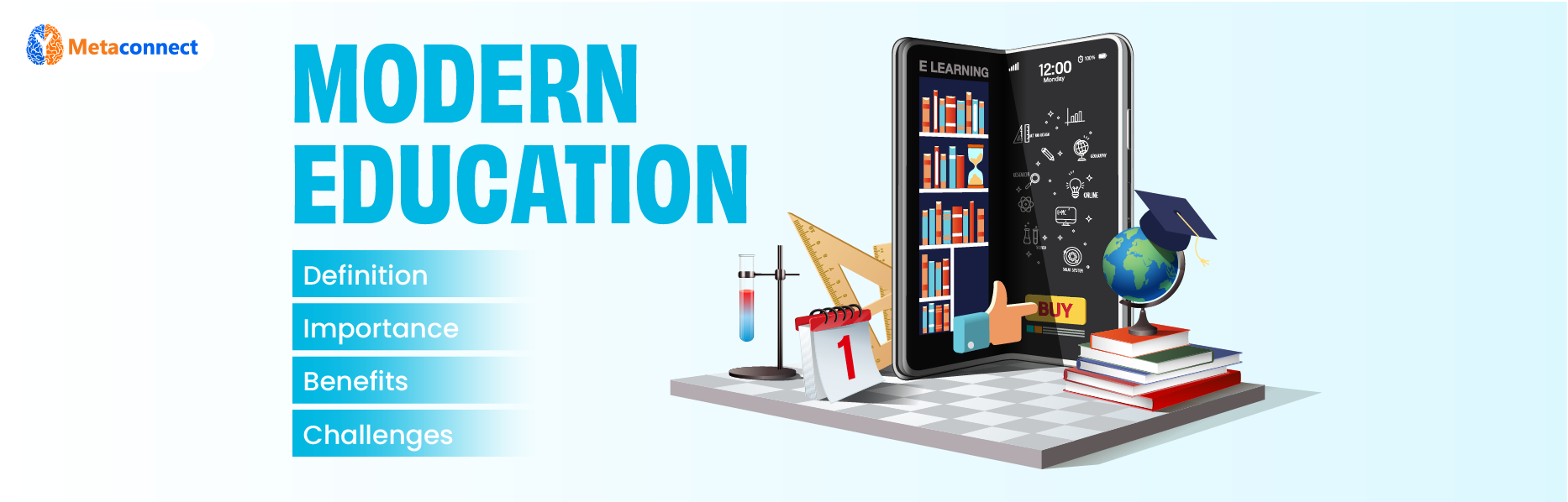
Modern Education: Definition, Importance, Benefits & Challenges
You must have noticed that classrooms today look very different from the past. In the 21st century, learning is no longer just about memorizing textbooks or completing assignments. Now, students are taught to explore concepts, solve problems, finish project tasks, and use technology to learn concepts better.
These lead to a single question: what really constitutes education in this present time?
Modern education system focuses on the concepts of knowledge and applying what one has learned in practical life. The idea is based on conventional methods and interactive participation. The students are actively involved in what is taught and discover knowledge by themselves. Simultaneously, they develop their confidence and communication abilities as well.
This blog explains what is modern education system, its importance, benefits, and challenges. Let's have a closer look at it.
What is Modern Education?
Modern education is a learning process that is designed to prepare learners for life, not just for passing the examinations. Unlike the conventional classroom setting, it involves understanding concepts, applying knowledge, and developing practical skills.
It utilizes the use of computers, smart educational resources, and modern teaching methods. Learners are also challenged to think, question, and figure out answers by themselves. Teachers also help students create short summaries for better understanding, so ideas stay clear and easy to remember.
Today's education system uses group work, discussions, laboratory work, and technology to make learning interactive. Learners can learn at their own pace and using their preferred methods.
Importance of Modern Education
The modern education system in India is essential because it leads to holistic development among learners, boosts their creativity, and builds critical thinking skills and problem-solving activities.
Below are the reasons that show the importance of contemporary education in the 21st century:
1. Prepares Students for Real Life
Today’s education is no longer purely based on memorization of facts. Students realize the connections between the classroom and the reality around them, which leads to better comprehension of the knowledge. They learn to apply knowledge practically, making education meaningful and useful.
2. Develops Critical Thinking and Problem-Solving
Learners are allowed to think for themselves and come up with new solutions to problems. The school of modern education cultivates them to be information analysts. idea comparers, and decision-makers with great confidence. The benefits are not limited to academics but rather extend to personal and future professional life.
3. Builds Technological and Digital Skills
Technology use is skyrocketing in the modern education system. The use of computers, educational apps, and online resources is all part of the student’s daily life; they are not just for exploring subjects but for learning on their own as well. Students also learn organizing information effectively, which helps them study better and manage knowledge in a structured way.
4. Encourages Creativity and Exploration
In the modern education system, learners are not only permitted to ask questions but also to try things out and think about things differently. This practice leads to developing kids' imaginative abilities, inquisitiveness, and self-reliance. They will have the power to see challenges from different angles and develop their self-esteem.
5. Prepares for Global Opportunities
Contemporary education exposes students to global perspectives. The children, by knowing the other cultures and the different points of view, will acquire the skills of communication and adaptability, which are the prerequisites for winning not just locally but globally too.
Advantages of Modern Education
There are many advantages associated with contemporary education that help make learning a success. Below are the advantages of modern education.
1. Improved Engagement
Modern classrooms are designed to support modern students’ learning needs. Every child learns differently, and this approach allows flexibility through activities, discussions, visuals, and digital tools, improving understanding.
2. Develops Life Skills
From contemporary education, learners acquire skills such as working in pairs or teams, communication, problem-solving, and creativity. These can be achieved through projects and presentations carried out in groups.
3. Hands-On Experience
"Learning by doing" is a characteristic of the modern education in India. Activities, projects, and experiments can all be used by the teacher to help learners to apply what they've learned. This approach makes lessons easier to understand.
4. Teamwork and Collaboration
Contemporary education emphasizes teamwork. This teaches the participants the importance of idea sharing, listening, and working together as a team. This will help in improving their social interactions, as well as help them for future work.
5. Technologies Integration
Digital applications and online resources improve learning. Students can learn at their own pace and delve deeper whenever they choose. The teacher can monitor their learning and help each one individually.
Challenges with Modern Education
Although there are benefits in contemporary education, there exist challenges. Here are the disadvantages of modern education.
1. Unequal Access to Technology
All learners may not have access to computers as well as the internet. As a result, there may be disparities in learning opportunities
2. Teacher Training
Teachers require proper training for the use of the latest technology and teaching techniques. Otherwise, even interactive learning might not be effectively handled.
3. Screen Time
Overdependence on technology can cause strain in the eyes and lead to reduced levels of exercise. Learning through technology should be balanced with offline exercises.
4. Skills Evaluation
Typical exams are based on memory rather than solving or creating. Ways are needed by schools to measure skills through projects/presentations and peer assessment.
5. Infrastructure Limits
Many of the schools do not have smart class technology or tools as well as internet connectivity. Without resources, the application of modern techniques is severely hindered.
Conclusion
The new system of education brings a change in the manner in which the students acquire knowledge, think, and prepare for their future. The modern education system emphasizes understanding, skill development, creativity, and finally, communicating ideas.
There are issues such as limits in technology availability, teacher professional development, evaluation, and infrastructure.
However, with proper planning, modern education can be an effective force in enabling every child to develop skills not only as an academic achiever but also as an individual as well. It equips them to face the challenges of life with confidence.



 Jumpstart Journal
 R-A-R Activity
 Critical Thinking Exercise
 Picture Reflection Or Photo Caption
 Presentation
 Thematic Apperception Test (TAT)
 Flash Card
 Micro Learning
 Research Skills
 Workshop Report Presentation
 MCQ And Descriptive Questions
 Video Analysis Presentation
 Scenario Planning
 Problem Solving
 Trivia Quiz
 Flipped Classroom
 Generative Knowledge Interviewing
 Think-Pair-Share
 Fish Bowl Group Activity
 Jigsaw Method
 Simulation
 Peer Interview
 Role Play
 Debate
 Group Discussion
 Futurism And Trend Analysis
 Report Presentation
 Assignment Presentation
 Research Article Review Presentation
 Peer Teaching
 Industrial Visit Report Presentation
 Video Podcast
 Games
Games
 Business Games
 Collaborative Project
 Team Building
 Role Reversal
 Leadership Activity
 Pitch Deck
 Case Analysis Presentation


 Learner
 Mentor
 Organisation
 Learner
 Mentor
 Organisation