14 August 2026
Scenario Planning: How to Prepare for a Future You Can't Predict
Most people prepare for the future by predicting it. They pick the most likely outcome, build one plan around it, and hope they guessed right. The problem is simple: the future rarely cooperates with a single guess.
Scenario planning takes a different approach. Instead of betting on one predicted outcome, it prepares you for several plausible ones so that whichever future actually arrives, you're not starting from zero. It's a skill used by strategists, business leaders, and policymakers, but it's just as valuable for a student choosing a career path or a professional navigating an uncertain industry.
This guide breaks down what scenario planning actually is, why it beats simple prediction, and how to build the skill step by step.
What Is Scenario Planning?
Scenario planning is a structured method for thinking through multiple plausible futures not just the one you expect and preparing a response for each. Rather than asking "what will happen?" it asks "what could happen, and how would I respond in each case?" This shifts the goal from being right about the future to being ready for it, regardless of which version unfolds.
Why Prediction Alone Fails
A single prediction feels efficient, but it has a hidden weakness: it's a bet, not a strategy. If the prediction is wrong and complex situations make that common the entire plan collapses with it. Scenario planning removes that fragility by preparing multiple branches in advance, so no single wrong guess can derail you completely.
The Scenario Planning Process, Step by Step
1. Define the Real Question
Start with a specific decision or uncertainty, not a vague worry. "Will I get a good job?" is too broad. "How should I prepare for the next two years if hiring in my field slows down?" is a real, workable question that scenario planning can actually address.
2. Identify the Key Uncertainties
List the two or three factors that would most change your outcome things you genuinely don't know yet. For a career decision, this might be industry demand, whether a skill becomes automated, or whether you relocate. Focus only on uncertainties that would meaningfully change your decision, not everything that could theoretically happen.
3. Build a Small Set of Plausible Scenarios
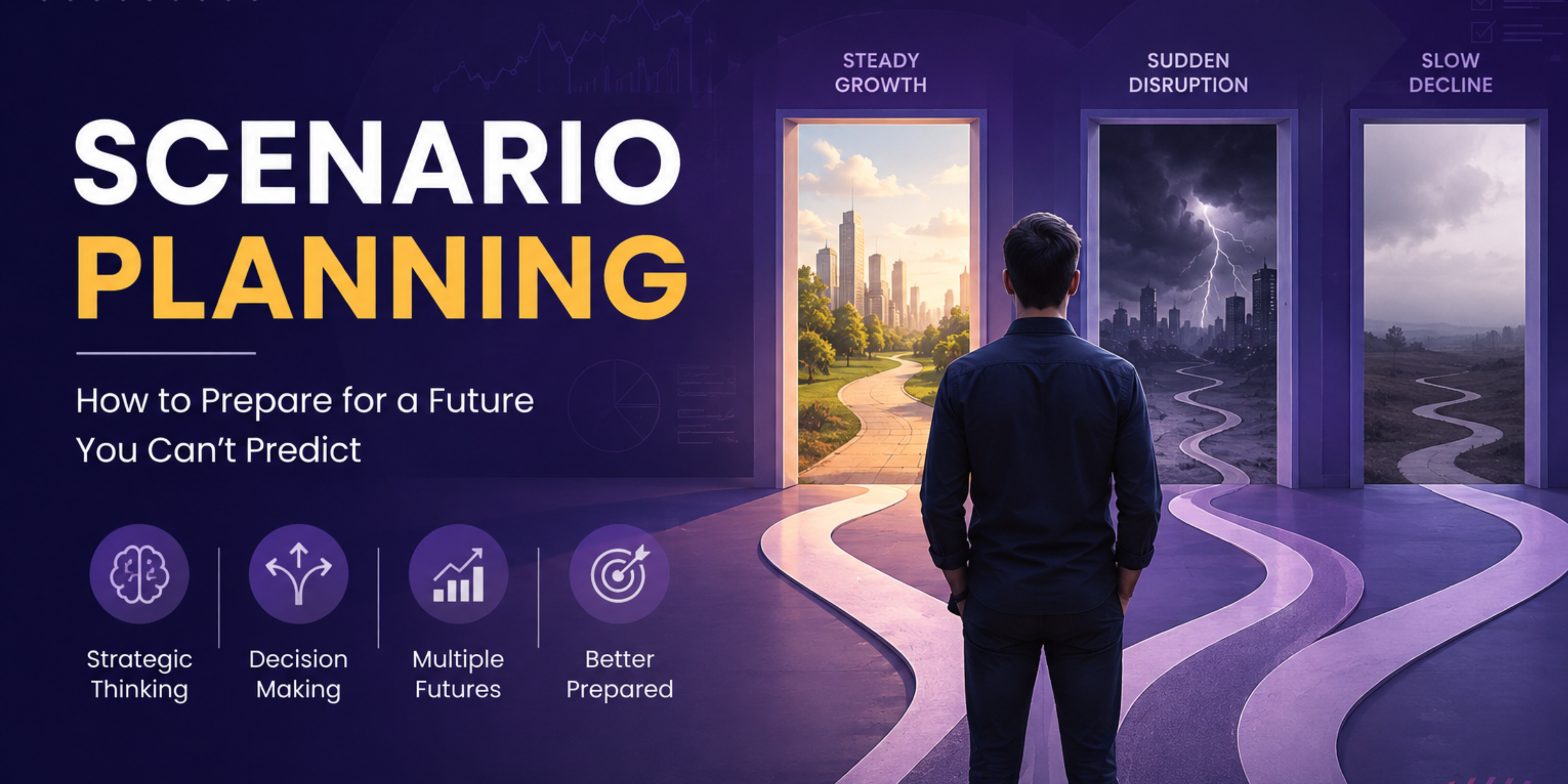
Combine your key uncertainties into 3–4 distinct, realistic scenarios not a best case and worst case only, since that leaves out everything in between. For example: a "steady growth" scenario, a "sudden disruption" scenario, and a "slow decline" scenario each tell a different story about what you'd need to do next.
4. Ask "What Would I Do If This Happened?" for Each One
This is the step most people skip imagining a scenario without deciding how you'd actually respond to it. For each scenario, write down the specific actions you'd take. This turns abstract "what ifs" into concrete, ready-to-use plans.
5. Look for Actions That Work Across Multiple Scenarios
Some responses only make sense in one specific future. Others like building a transferable skill, strengthening your network, or keeping savings flexible hold up well no matter which scenario plays out. Prioritize these "no-regret" moves first, since they pay off regardless of which future arrives.
6. Revisit and Update as New Information Arrives
Scenario planning isn't a one-time exercise. As real events unfold, some scenarios become more likely and others fade. Periodically revisit your scenarios and adjust the goal is to stay ready, not to lock in a plan and forget it.
Scenario Planning in Everyday Decisions
You don't need a boardroom to use this. A student choosing between two career tracks can map out scenarios for each ("if AI adoption accelerates in this field," "if it stays steady," "if it slows"). A job seeker can plan for scenarios around a company's hiring freeze, a delayed offer, or a competing opportunity. The framework scales down just as well as it scales up.
Why Scenario Planning Matters More in an Uncertain Job Market
Industries are shifting faster than most career plans account for new tools, automation, and market changes can reshape a field within a couple of years. Relying on a single prediction about "what my career will look like" is riskier than it used to be. Scenario planning gives you a way to stay prepared across multiple versions of the future, rather than being caught off guard by the one you didn't plan for.
Building the Habit: Review, Action, Reflect
Scenario planning connects naturally to a structured thinking habit rather than a one-off exercise:
Review the situation and the real uncertainties driving it not just the obvious ones
Act by mapping out specific responses for each plausible scenario, not just identifying them
Reflect on which scenario is becoming more likely as new information comes in, and adjust accordingly
This Review-Action-Reflection loop is the same structured thinking approach behind YMetaconnect's RAR framework applied here to strategic, forward-looking decisions instead of just exam content.
Final Takeaway
Scenario planning isn't about predicting the future correctly it's about not being blindsided by it. By identifying key uncertainties, building a small set of realistic scenarios, and preparing a response for each, you replace a fragile single guess with a flexible, ready-for-anything plan. It's a skill worth building deliberately, whether you're mapping out a career path, a business decision, or your next two years of study.
Explore how YMetaconnect's RAR framework builds structured thinking skills like this turning uncertainty into a plan you can actually act on.



 Jumpstart Journal
 R-A-R Activity
 Critical Thinking Exercise
 Picture Reflection Or Photo Caption
 Presentation
 Thematic Apperception Test (TAT)
 Flash Card
 Micro Learning
 Research Skills
 Workshop Report Presentation
 MCQ And Descriptive Questions
 Video Analysis Presentation
 Scenario Planning
 Problem Solving
 Trivia Quiz
 Flipped Classroom
 Generative Knowledge Interviewing
 Think-Pair-Share
 Fish Bowl Group Activity
 Jigsaw Method
 Simulation
 Peer Interview
 Role Play
 Debate
 Group Discussion
 Futurism And Trend Analysis
 Report Presentation
 Assignment Presentation
 Research Article Review Presentation
 Peer Teaching
 Industrial Visit Report Presentation
 Video Podcast
 Games
Games
 Business Games
 Collaborative Project
 Team Building
 Role Reversal
 Leadership Activity
 Pitch Deck
 Case Analysis Presentation


 Learner
 Mentor
 Organisation
 Learner
 Mentor
 Organisation