24 March 2026
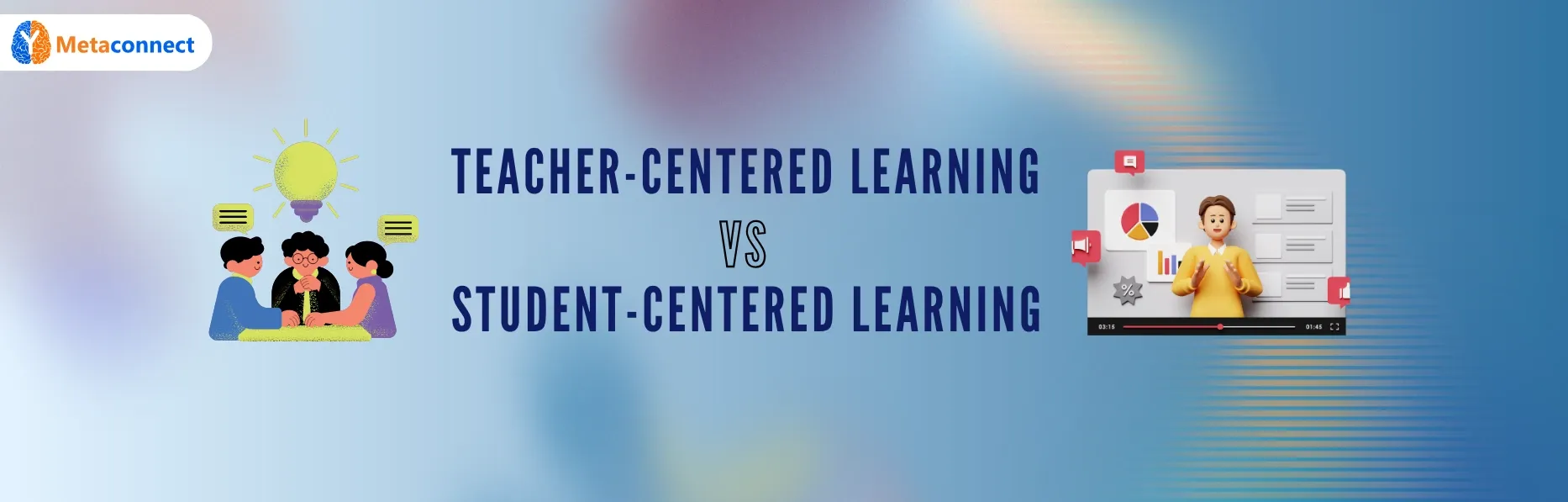
Teacher-Centered Learning vs Student-Centered Learning
Education is no longer just about delivering information, it’s about how effectively that information is understood, applied, and retained. Over time, teaching methods have evolved, giving rise to two major approaches: teacher centered and learner centered learning.
While one focuses on structured instruction led by educators, the other emphasizes active participation and independence from learners. Understanding these approaches is essential for students, educators, and even parents who want to choose the most effective learning style.
In this blog, we’ll explore both methods in detail, compare their differences, and help you understand which approach works best in modern education.
What is Teacher-Centered Learning?
The teacher-centered learning method of learning and education is a conventional method of learning and imparting education in which the teacher plays the main role in imparting education.
In the teacher-centered method of learning, the learning environment is highly structured, and the teacher takes total control of the learning of the students. The teacher centered curriculum of learning involves lectures, note-taking, and direct instruction.
In this method, students are expected to listen, observe, and learn rather than participating actively in the learning process. This method focuses entirely on covering the syllabus and ensuring all students receive the same knowledge at the same time.
What is Student-Centered Learning?
Student-centered learning is based on the idea of shifting the attention from the teacher to the student. In student-centered learning, the students are not only listening to the teacher. They are also participating in the learning process.
In addition to this, the students are given the freedom to learn the way they want. This makes the learning process interesting and comfortable for the students. Student-centered learning is characterized by various features.
In student-centered learning, the teacher may use group discussions, activities, puzzles, etc. In the conventional method of learning, the teacher only talks. In student-centered learning, the teacher encourages the students to participate.
Teacher-Centered Learning vs Student-Centered Learning
When comparing teacher centered and learner centered learning, the key difference lies in who takes control of the learning process.
Here’s a clear breakdown to understand it better:
- Control of Learning:
In a teacher-centered setup, the teacher leads the class and controls the flow of information.
In a learner-centered environment, students take an active role in their learning journey.
- Teaching Style:
The teacher centered method of teaching focuses on lectures, structured lessons, and direct instruction.
The student centered definition approach involves discussions, activities, and interactive learning.
- Learning Focus:
Teacher-centered learning emphasizes completing the syllabus and delivering content efficiently.
Student-centered learning prioritizes understanding, critical thinking, and practical application.
- Student Involvement:
In teacher-centered classrooms, students are mostly passive listeners.
In student-centered settings, students actively participate, ask questions, and collaborate.
- Skill Development:
Teacher-centered learning helps build a strong academic foundation.
Student-centered learning develops essential life skills like problem-solving, communication, and independence.
Both approaches have their own importance, and when used together, they can create a more balanced and effective learning experience.
To better understand the contrast between these two approaches, here’s a simple comparison:
|
Aspect
|
Teacher-Centered Learning
|
Student-Centered Learning
|
|
Role of the Teacher
|
Main authority and knowledge provider
|
Facilitator and guide
|
|
Role of the Student
|
Passive listener
|
Active participant
|
|
Teaching Style
|
Lectures and direct instruction
|
Discussions, activities, and collaboration
|
|
Learning Pace
|
Fixed for all students
|
Flexible and personalized
|
|
Focus
|
Completing syllabus
|
Understanding and skill development
|
|
Classroom Interaction
|
Limited
|
High level of engagement
|
|
Creativity
|
Less encouraged
|
Strongly encouraged
|
|
Assessment
|
Exams and tests
|
Projects, presentations, and continuous evaluation
|
This comparison clearly highlights how teacher centered and student centered meaning differ in terms of learning experience and outcomes.
Which Approach is Better for Modern Education?
It is not as simple as opting for one over the other. The fact of the matter is that both have their own advantages.
Now, let us discuss the above-stated matter in a simple manner.
- It is to be noted here that the teacher-centered method is very effective when new and complex concepts are to be taught. It is because new and complex concepts are to be clearly explained.
- It is also useful when discipline is to be maintained within the class. It is also useful when the syllabus is to be finished within a limited time frame.
- On the other hand, it seems that the student-centered method is more concerned with imparting knowledge that would be used in real-life situations, such as critical thinking skills, creativity, and problem-solving skills.
- With the student-centered method, students are provided with an active role in discussions and learn more by asking questions, making it an interesting experience for them.
- It is also moving towards a more liberal and dynamic education system in which students are not just passive listeners.
- This is imperative as it emphasizes the necessity for the student-centered method, which enables students to achieve their goals in spite of real-life situations and dynamics.
- However, it seems that if only one of these methods is used, it will not be for the optimal performance of the students. By using both of these methods, it becomes imperative for the students to gain good knowledge from their teachers.
- To sum it up, it is not about whether it is the teacher-centered method or the learner-centered method; it is more about how both of these methods have to be combined for an effective outcome.
- This will enable the students to receive good guidance and, at the same time, become independent learners.
To put it in simple words, it seems that for effective education in this modern world, it is a matter of finding a middle ground and using the advantages of both methods for an effective and interesting outcome.
Conclusion
Since education is a dynamic phenomenon, it is essential to know the various teaching methods. Both teacher-centered and learner-centered methods have greatly contributed to the lives of learners in one way or another.
Although the teacher-centered method of teaching is well organized and systematic, the learner-centered method of teaching is more creative and empowering. Both methods have their own advantages. If both methods are well utilized, they can complement each other.
The future of education is all about creating a balance between teaching and empowering the learner to be in charge of their own learning. By utilizing the advantages of both methods, we can create a learning environment that is not only creative and empowering but also informative.



 Jumpstart Journal
 R-A-R Activity
 Critical Thinking Exercise
 Picture Reflection Or Photo Caption
 Presentation
 Thematic Apperception Test (TAT)
 Flash Card
 Micro Learning
 Research Skills
 Workshop Report Presentation
 MCQ And Descriptive Questions
 Video Analysis Presentation
 Scenario Planning
 Problem Solving
 Trivia Quiz
 Flipped Classroom
 Generative Knowledge Interviewing
 Think-Pair-Share
 Fish Bowl Group Activity
 Jigsaw Method
 Simulation
 Peer Interview
 Role Play
 Debate
 Group Discussion
 Futurism And Trend Analysis
 Report Presentation
 Assignment Presentation
 Research Article Review Presentation
 Peer Teaching
 Industrial Visit Report Presentation
 Video Podcast
 Games
Games
 Business Games
 Collaborative Project
 Team Building
 Role Reversal
 Leadership Activity
 Pitch Deck
 Case Analysis Presentation


 Learner
 Mentor
 Organisation
 Learner
 Mentor
 Organisation