28 January 2026
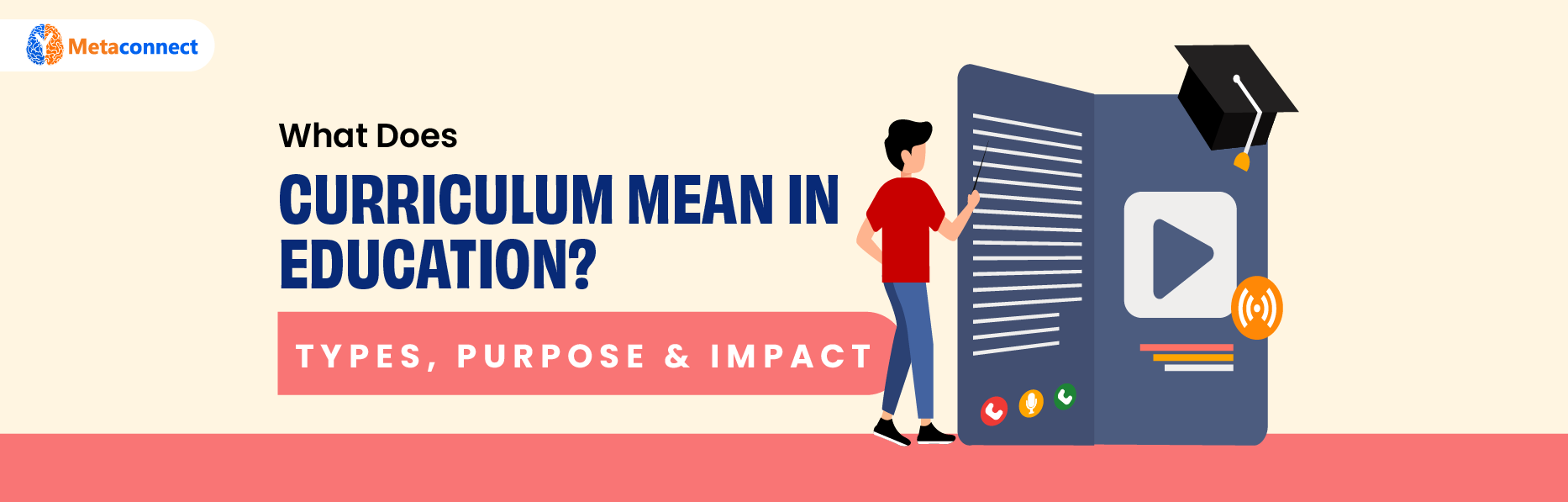
What Does Curriculum Mean in Education? Types, Purpose, and Impact
Education does not happen by chance. Behind every lesson, activity, and assessment, there is a clear plan. That plan is called the education curriculum. It represents the framework that guides teaching and learning across schools and institutions.
From early schooling to higher studies, the curriculum guides the learning journey step by step. It connects knowledge with real-life skills and values. Without a clear curriculum, teaching loses direction, and students feel confused. It provides a structured learning plan for students that connects knowledge, skills, and values in a meaningful way.
As education needs change, the curriculum meaning in education also adapts to meet new goals. Understanding it helps parents, teachers, and learners see how education works as a complete system, not just a list of subjects.
This blog explains what is curriculum in detail. Let’s explore it.
What is Curriculum in Education?
Curriculum meaning in education refers to the planned learning experiences in schools that include subjects, learning goals, teaching methods, activities, and assessment strategies designed to support student growth. A well-designed curriculum provides a clear structure for organizing learning content, helping teachers plan lessons systematically and ensuring students progress with clear learning goals.
It includes subjects, learning goals, teaching methods, activities, and assessment plans. It explains what students should learn and how learning should take place.
Understanding what curriculum means in education goes beyond textbooks. It also covers skills, values, and attitudes students are expected to develop. A well-planned curriculum supports both academic learning and personal development.
It helps schools maintain consistency while allowing teachers to plan lessons with clear goals. In simple terms, it is the roadmap of learning.
What is the Importance of Curriculum?
Curriculum plays a key role in shaping education quality. With a clear education curriculum, teachers know what to teach, and students know what to learn. An effective education curriculum connects classroom learning with real-world needs by supporting applying learning to real-life problems, making education practical, relevant, and meaningful for students.
It helps maintain balance between knowledge, skills, and values. Curriculum meaning in education, also ensures equal learning opportunities for all students. It supports long-term planning and fair assessment. Another important role is relevance.
An education curriculum connects learning with real-life needs. It prepares students for further studies, work, and social responsibilities. When the curriculum is strong, education becomes meaningful, organized, and goal-focused.
The importance of curriculum lies in how curriculum shapes student development by balancing academic knowledge with personal, social, and emotional growth throughout the learning process.
Types of Curriculum in Education
The concept of curriculum appears in different forms to meet learning needs. Each type serves a clear purpose and supports students in unique ways. Here are the types of curriculum in education.
➢ Formal or Explicit Curriculum
The formal or explicit curriculum is the officially written plan of education. It includes learning objectives, prescribed content, lesson plans, textbooks, and standards that guide what teachers teach and what students are expected to learn.
➢ Hidden or Implicit Curriculum
The hidden or implicit curriculum includes values, attitudes, behavior, discipline, and social norms learned indirectly through school culture, teacher behavior, classroom routines, and peer interactions rather than formal instruction.
➢ Learner-Centered Curriculum
The learner-centered curriculum focuses on individual students’ needs, interests, abilities, and learning pace. This approach supports individual progress by encouraging self-paced learning strategies for students, allowing learners to study according to their abilities and learning speed.
➢ Subject-Centered Curriculum
The subject-centered curriculum organizes learning into separate subjects such as mathematics, science, and history. The main focus is on content mastery, academic knowledge, and systematic coverage of each discipline.
➢ Integrated Curriculum
The integrated curriculum connects multiple subjects through common themes, concepts, or real-life situations. An integrated curriculum promotes teamwork and interaction through collaborative approaches to classroom learning, helping students share ideas and learn through cooperation.
➢ Activity-Based Curriculum
This emphasizes learning through hands-on activities, projects, experiments, and real-life experiences. It promotes practical skills, problem-solving ability, and a deeper understanding through active student involvement.
➢ Null Curriculum
The null curriculum refers to content or topics that are intentionally excluded from teaching. What is not taught may reflect social values, priorities, or beliefs about what knowledge is considered important.
➢ Recommended Curriculum
The recommended curriculum is suggested by education experts, policymakers, or professional bodies. It provides guidelines, frameworks, and suggestions that schools may adapt according to their goals and learners’ needs.
➢ Supported or Assessed Curriculum
The supported or assessed curriculum includes teaching materials, digital tools, textbooks, and assessment methods. It ensures that learning objectives are properly taught, supported, and evaluated through structured testing and feedback.
What is the Difference Between Curriculum and Syllabus?
Curriculum and syllabus are closely linked, but they are not the same. Understanding the difference helps clarify how education is planned and delivered. Here is the clear difference between curriculum and syllabus.
|
Aspect
|
Curriculum
|
Syllabus
|
|
Scope
|
Broad learning plan
|
Subject-focused outline
|
|
Coverage
|
Includes goals, skills, values
|
Lists topics and units
|
|
Purpose
|
Guides the complete learning process
|
Guides subject teaching
|
|
Flexibility
|
More adaptable
|
Less flexible
|
|
Focus
|
Overall development
|
Academic content
|
From the above table, it is clear that the curriculum covers the entire learning experience, while the syllabus focuses on subject content. Curriculum meaning in education helps in setting direction, while the syllabus supports lesson planning.
Role of Curriculum in Teaching and Learning
Curriculum plays a central role in shaping classroom experiences. It connects teaching methods with learning goals. Curriculum supports fair evaluation by guiding assessment-driven learning approaches, ensuring tests and activities match learning objectives and student understanding.
➢ Guides Teachers
The concept of curriculum provides clear teaching direction. It helps teachers plan lessons and choose methods. With clear goals, teachers stay focused and organized.
➢ Supports Student Learning
Students benefit from structured learning paths. Curriculum planning benefits from understanding learner behavior and thinking patterns, which helps address cognitive and emotional growth.
➢ Ensures Consistency
It creates uniform learning standards. Students across schools receive similar learning opportunities. This ensures fairness and quality.
➢ Encourages Skill Development
The modern curriculum focuses on thinking, communication, and problem-solving. These skills help students handle real-life challenges.
➢ Helps Assessment Planning
It guides how learning is measured. It helps teachers design fair tests and activities. Assessment stays aligned with learning goals.
➢ Promotes Holistic Growth
Curriculum supports academic, emotional, and social growth. It balances knowledge with values and life skills.
Challenges in Curriculum Implementation
Even strong curriculum plans face challenges during execution. These issues affect teaching quality and learning outcomes. Here are the challenges
➢ Lack of Resources
Limited materials and tools affect delivery. Without proper support, teachers struggle to meet curriculum goals.
➢ Teacher Training Gaps
Teachers need proper training to apply the curriculum effectively. Lack of guidance leads to uneven implementation.
➢ Student Diversity
Students learn at different speeds. Curriculum may not always address individual learning needs. This creates learning gaps.
➢ Time Constraints
Tight schedules affect lesson completion. Teachers rush through content, reducing understanding and engagement.
➢ Outdated Content
Curriculum must stay relevant. Old content fails to meet current learning needs and career demands.
➢ Technology Barriers
Digital curriculum needs access to devices and the internet. Limited access affects learning continuity.
Conclusion
The education curriculum plays a vital role in shaping effective teaching and meaningful learning. It provides clear direction, ensures consistency, and supports balanced academic and skill development.
A well-designed curriculum helps students grow intellectually, socially, and emotionally while preparing them for real-life challenges. Although challenges such as limited resources and training gaps exist, continuous review and adaptation can improve curriculum implementation.
When thoughtfully planned and properly executed, the curriculum strengthens the education system and supports long-term student success. Ultimately, a strong curriculum creates organized, purposeful, and inclusive learning experiences for all learners.



 Jumpstart Journal
 R-A-R Activity
 Critical Thinking Exercise
 Picture Reflection Or Photo Caption
 Presentation
 Thematic Apperception Test (TAT)
 Flash Card
 Micro Learning
 Research Skills
 Workshop Report Presentation
 MCQ And Descriptive Questions
 Video Analysis Presentation
 Scenario Planning
 Problem Solving
 Trivia Quiz
 Flipped Classroom
 Generative Knowledge Interviewing
 Think-Pair-Share
 Fish Bowl Group Activity
 Jigsaw Method
 Simulation
 Peer Interview
 Role Play
 Debate
 Group Discussion
 Futurism And Trend Analysis
 Report Presentation
 Assignment Presentation
 Research Article Review Presentation
 Peer Teaching
 Industrial Visit Report Presentation
 Video Podcast
 Games
Games
 Business Games
 Collaborative Project
 Team Building
 Role Reversal
 Leadership Activity
 Pitch Deck
 Case Analysis Presentation


 Learner
 Mentor
 Organisation
 Learner
 Mentor
 Organisation