28 April 2026
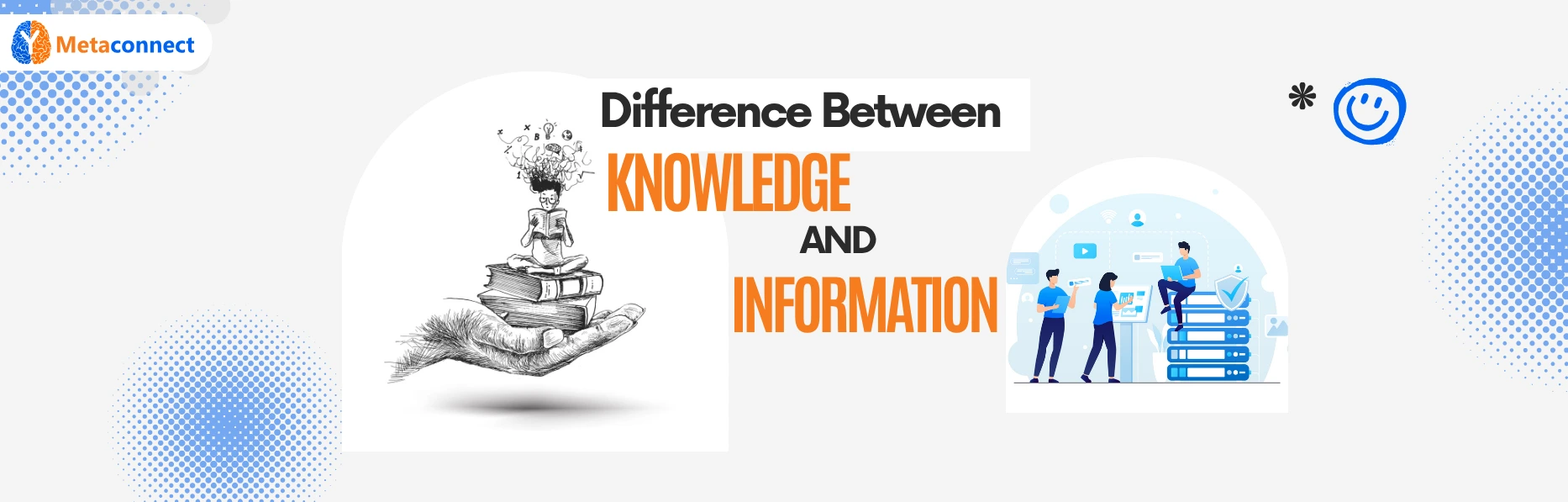
Difference Between Knowledge and Information
You read something online. You understand the words. You move on. It feels like you’ve learned something.
But a few hours later, if someone asks you to explain it, you pause. You remember bits, but not the full idea.
That’s the moment where the gap shows up. You had information, but you didn’t build knowledge.
Most people don’t notice this difference in information vs knowledge because both feel similar on the surface. But once you start paying attention, the distinction becomes clear. And once it becomes clear, the way you learn begins to change.
So, before we compare the difference between knowledge and information, let’s understand them one by one.
What Is Knowledge?
Let’s start with something familiar.
Think about a skill you actually know well. Perhaps it’s solving a specific problem, explaining a complex topic, or handling a real-life situation with confidence. You don’t just recall facts. You understand what to do and why it works.
That’s knowledge.
It doesn’t come from a single reading or a quick explanation. It builds slowly, as you connect ideas, test them, and see how they work in different situations.
For example, you may read that practice improves performance. That’s easy to remember. But when you apply it, notice patterns, adjust your approach, and see results, it starts turning into something deeper.
That’s when information begins to take shape as knowledge. And this process becomes stronger when you actively engage with what you learn through individual activities that push you to think, reflect, and apply concepts in real situations.
➣ Characteristics of Knowledge
Now that the idea is clearer, its nature becomes easier to see. The characteristics of knowledge are as follows:
- It is built on understanding, not just memory.
- It develops through experience and reflection.
- It helps you make decisions, not just recall facts.
- It connects different ideas into a bigger picture.
- It stays with you because you’ve worked through it.
This is why knowledge feels stable. You don’t have to force it. It makes sense on its own.
➣ Types of Knowledge
As knowledge grows, it doesn’t stay in one form. It shows up in different ways depending on how you learn and use it. The types of knowledge are as follows:
- Practical Knowledge
This comes from doing things yourself. The more you practice, the clearer it becomes.
- Theoretical Knowledge
This is built through concepts and structured learning. It gives you a framework to think.
- Experiential Knowledge
This develops through real situations, especially when things don’t go as planned.
- Implicit Knowledge
This is what you know without consciously thinking about it. It becomes part of how you act.
As you move between these types, your understanding deepens. And that naturally brings us to the other side of the discussion.
What Is Information?
Before knowledge forms, something has to come first. That starting point is information.
Information is what you come across every day. It could be a definition, a fact, a statistic, or even a simple explanation.
At first glance, it feels complete. It gives you clarity for the moment. But it doesn’t go very far on its own.
You can read a topic multiple times and still feel unsure when you try to apply it. This is where using the right approach matters. When you apply effective learning methods, information becomes easier to understand, retain, and apply in real situations.
So while knowledge grows from within, information usually comes from outside.
➣ Characteristics of Information
Information follows a clear pattern. It is simple to access but not always easy to retain or apply. The characteristics of information are as follows:
- Fact-based and objective
Information is built on facts, data, and verified details. It does not depend on personal opinions or experiences.
- Easily shared and transferred
It can be communicated through books, videos, or digital platforms, making it widely accessible to everyone.
- Independent of personal understanding
Information exists on its own. It does not require interpretation to exist, but it needs thinking to become useful.
- Short-term in nature
Without revision or application, information is often forgotten quickly after learning.
- Available in large amounts
With digital access, information is everywhere, which makes it easy to collect but harder to filter.
➣ Types of Information
Information appears in different forms depending on how it is created and shared. The types of information are as follows:
- Raw Data
This includes basic facts, numbers, or figures that have not been processed or explained.
- Structured Information
Organized data presented in reports, tables, or formats that make it easier to understand.
- Digital Information
Content available online, such as blogs, videos, websites, and social media posts.
- Visual Information
Graphs, charts, and images that present information in a visual and easy-to-grasp format.
Key Difference Between Knowledge and Information
Now that both knowledge vs information in education are clear on their own, the difference between knowledge and information becomes easier to understand.
To make this clearer, let’s differentiate between knowledge and information side by side.
|
Basis
|
Information
|
Knowledge
|
|
Definition
|
Information is processed data that gives facts or details about something.
|
Knowledge is the understanding gained by interpreting and applying that information.
|
|
Nature
|
Objective and factual.
|
Subjective and based on experience and thinking.
|
|
Source
|
It originates from external sources, such as books, the internet, or data.
|
Built internally through learning, reflection, and experience.
|
|
Form
|
Exists in the form of text, numbers, visuals, or audio.
|
Exists in the human mind as understanding and insight.
|
|
Depth
|
Surface-level understanding.
|
Deep and meaningful understanding.
|
|
Dependence
|
Does not require thinking to exist.
|
It completely depends on thinking and interpretation.
|
|
Usage
|
Used to inform or provide awareness.
|
Used to solve problems and make decisions.
|
|
Stability
|
Can change frequently as new data comes in.
|
Grows stronger and more stable over time.
|
|
Learning Style
|
Passive learning, like reading or listening.
|
Active learning, like applying, analyzing, and practicing.
|
|
Retention
|
Often short-term if not processed.
|
Long-term because it is understood and applied.
|
|
Value
|
Limited if not used properly.
|
High value in real-life situations.
|
|
Example
|
Knowing the formula of a concept
|
Understanding when and how to apply that formula.
|
What this difference between knowledge and information shows is the gap between collecting facts and truly understanding them. Information is easy to gather, but it often remains scattered and fleeting. Knowledge forms when you process, connect, and apply that information in real situations.
If you look closely, this is exactly why simple habits like reading with intent matter so much. When you actively engage with what you read, instead of just skimming, it starts building a deeper understanding. You can explore this idea further in 10 powerful benefits of reading books for knowledge and personal growth.
While information gives you awareness, knowledge gives you clarity and direction. In simple terms, the difference between knowledge and information is that information fills your mind, but knowledge shapes how you think, act, and handle situations with confidence.
Conclusion
In the end, information and knowledge are closely linked, but the difference between knowledge and information is not the same. Information is where everything begins. It introduces ideas and gives you something to work with.
But on its own, it has limited value. The real impact comes when you take that information, think about it, and apply it in different situations. That process turns it into knowledge. Over time, this builds confidence and better decision-making.
So instead of just collecting information, the focus should always be on understanding it deeply. That shift makes learning more meaningful, practical, and useful in real life.



 Jumpstart Journal
 R-A-R Activity
 Critical Thinking Exercise
 Picture Reflection Or Photo Caption
 Presentation
 Thematic Apperception Test (TAT)
 Flash Card
 Micro Learning
 Research Skills
 Workshop Report Presentation
 MCQ And Descriptive Questions
 Video Analysis Presentation
 Scenario Planning
 Problem Solving
 Trivia Quiz
 Flipped Classroom
 Generative Knowledge Interviewing
 Think-Pair-Share
 Fish Bowl Group Activity
 Jigsaw Method
 Simulation
 Peer Interview
 Role Play
 Debate
 Group Discussion
 Futurism And Trend Analysis
 Report Presentation
 Assignment Presentation
 Research Article Review Presentation
 Peer Teaching
 Industrial Visit Report Presentation
 Video Podcast
 Games
Games
 Business Games
 Collaborative Project
 Team Building
 Role Reversal
 Leadership Activity
 Pitch Deck
 Case Analysis Presentation


 Learner
 Mentor
 Organisation
 Learner
 Mentor
 Organisation