26 February 2026

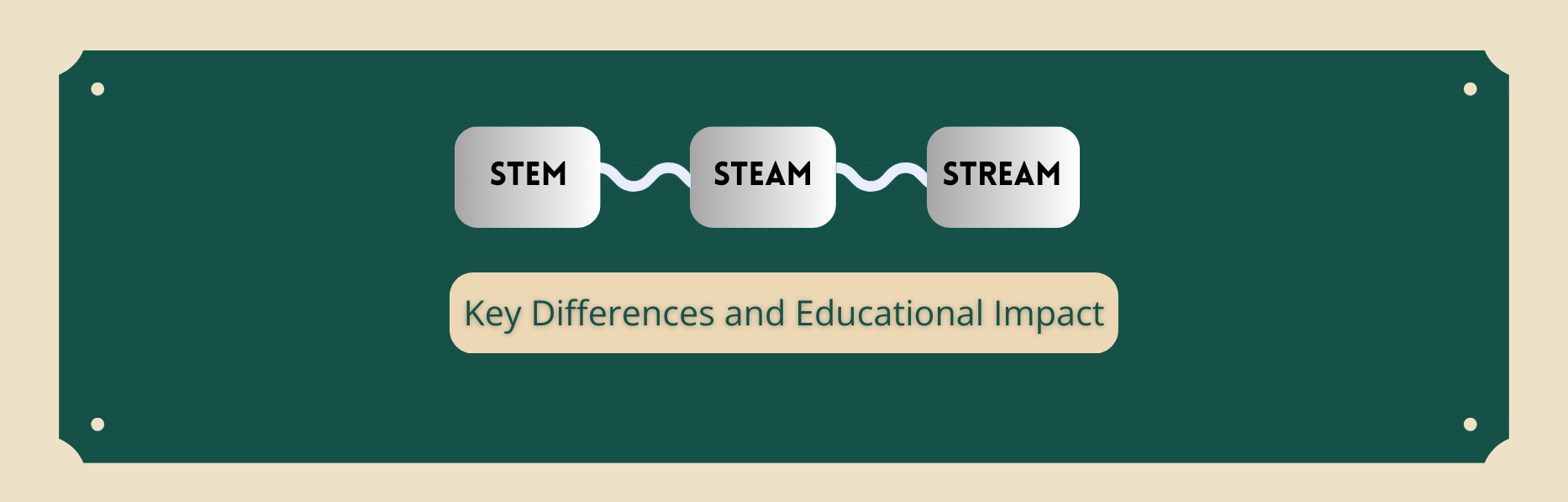
STEM, STEAM, and STREAM Explained: Key Differences and Educational Impact

A child makes a bridge with popsicle sticks. Then they test the weight limit of the bridge. Next, they write about what they did well and what they did not. Finally, they create a poster to describe their concept.

This single activity encompasses science, math, writing, creativity, and design. And this is how the modern classroom is shifting.

Perhaps you have heard of the terms STEM, STEAM, and now STREAM. The acronyms appear to be similar, but each has something new to offer. STEM was first introduced. Then, STEAM introduced art. Now, the STREAM approach to learning introduces reading and writing.

But what is the actual difference? And why is it important for the modern classroom?
This blog explains the key differences in STEM vs STEAM vs STREAM. Let’s check this out in detail.
 

Breaking It Down: STEM vs STEAM vs STREAM

All three modern learning approaches aim to connect subjects and make learning practical. The difference lies in which subjects are included and how broad the learning experience becomes.

Let’s see the comparison in STEM vs STEAM vs STREAM in the table given below.

Feature

STEM

STEAM

STREAM

Full Form

Science, Technology, Engineering, Mathematics

Science, Technology, Engineering, Arts, Mathematics

Science, Technology, Reading, Engineering, Arts, Mathematics

Focus

Technical skills and problem-solving

Technical skills plus creativity

Technical skills, creativity, and literacy

Role of Arts

Not included

Included for creativity

Included for creative thinking and expression

Role of Reading

Not highlighted

Not highlighted

Strong focus on reading and comprehension

Learning Style

Logical and analytical

Logical with creative expression

Logical, creative, and language-based

Communication Skills

Limited focus

Moderate focus

Strong focus

Ideal For

Technical careers

Creative and technical paths

Balanced academic growth


From the table above, you can see how each one builds on the last. STEM is primarily concerned with technical skills. STEM improves logic, math, and analytical problem-solving skills. STEAM then introduces art, which introduces creativity and design thinking. This makes learning more expressive, not just analytical.

When we look at STEM vs STEAM vs STREAM, the most noticeable difference is in STREAM. STREAM education adds reading and writing, which improve understanding and communication. 

In the debate of STEM vs STEAM vs STREAM, STREAM usually takes center stage because it provides a more balanced learning experience that enhances technical skills as well as language skills.
 

Why Does STREAM Matter in Science Education?

Now that we know the difference between these approaches, the question is this: Why is STREAM so important to science education?

Here is the short answer. Science is more than just conducting experiments or learning vocabulary words. Students must be able to read directions well, record observations accurately, discuss results, and sometimes even give presentations for their ideas. STREAM in education encompasses all of these activities.

By incorporating reading, writing, and science, students comprehend ideas better. By incorporating art, they can create models. Math enables them to analyze. Technology enables them to test their ideas in a smarter way.

That combination makes science learning deeper, clearer, and more useful in real life.
 

Why STREAM Learning is the Future?

But what is the future of education? If you observe, education is moving towards learning that feels relevant and applicable. This is exactly why STREAM education is in the limelight.

Today, the world requires more than just knowledge. Children need to be able to think clearly, solve problems, express their ideas, and be able to adapt to changing situations. STREAM education develops all these skills simultaneously. It does not separate logic from thinking and creativity or reading and science. All these happen simultaneously.

Children learn in this manner and are thus better equipped to handle actual challenges in life, not just in the classroom. This is why many people consider STREAM to be the future of modern education.
 

Conclusion

Education is no longer just about covering subjects one by one. It is about helping students see how ideas connect and how knowledge works in real life. That is where the difference between STEM vs STEAM vs STREAM becomes meaningful. 

Each step expanded learning, but STREAM brings together logic, creativity, and language in one complete approach.

Many people still wonder, What is STREAM education? It is a way of teaching that blends subjects instead of keeping them separate. This approach encourages interdisciplinary learning, where students connect science, math, art, and reading naturally.

When learning feels connected, it becomes deeper, clearer, and more practical.

Fequently asked questions

Yes, these approaches can work for all learners when adapted properly. They support different strengths, encourage active learning, and help students build skills in logic, creativity, reading, and collaboration across age groups.

The best approach depends on learning goals, but STREAM offers a more balanced experience. It combines technical subjects, creativity, and reading skills, helping students develop strong thinking, communication, and problem-solving abilities.

Any student who has an interest in science, technology, engineering, or mathematics can choose STEM. There is no special restriction. Curiosity, problem-solving ability, and willingness to learn are the main requirements.

It is called STEAM because the arts were added to STEM subjects. Educators believed creativity and design are important alongside science and math, so the extra “A” represents arts in the learning model.

Both terms are correct and used in education. STEM focuses on science, technology, engineering, and mathematics. STEAM includes all of these subjects but also adds the arts to support creativity and imagination in learning.