26 February 2026
STREAM in Action: How Science, Technology, Reading, Engineering, Art, and Math Are Changing Modern Education?
What if children could learn science, math, art, and reading all at the same time while solving real-world problems? This is what STREAM education is all about. Children need more than just answers from a textbook. They need to think critically, ask questions, create things, and communicate their ideas with confidence.
STREAM education helps children do all these things. It links different subjects rather than teaching them separately. Children don’t just memorize answers; they discover, experiment, design, and create. Schools are gradually adopting this approach because it readies children for the real world.
In this blog, we will learn what STREAM is all about, why it is important, and how schools can implement it in a simple and effective manner.
What Does STREAM Stand For and Why Is It Important?
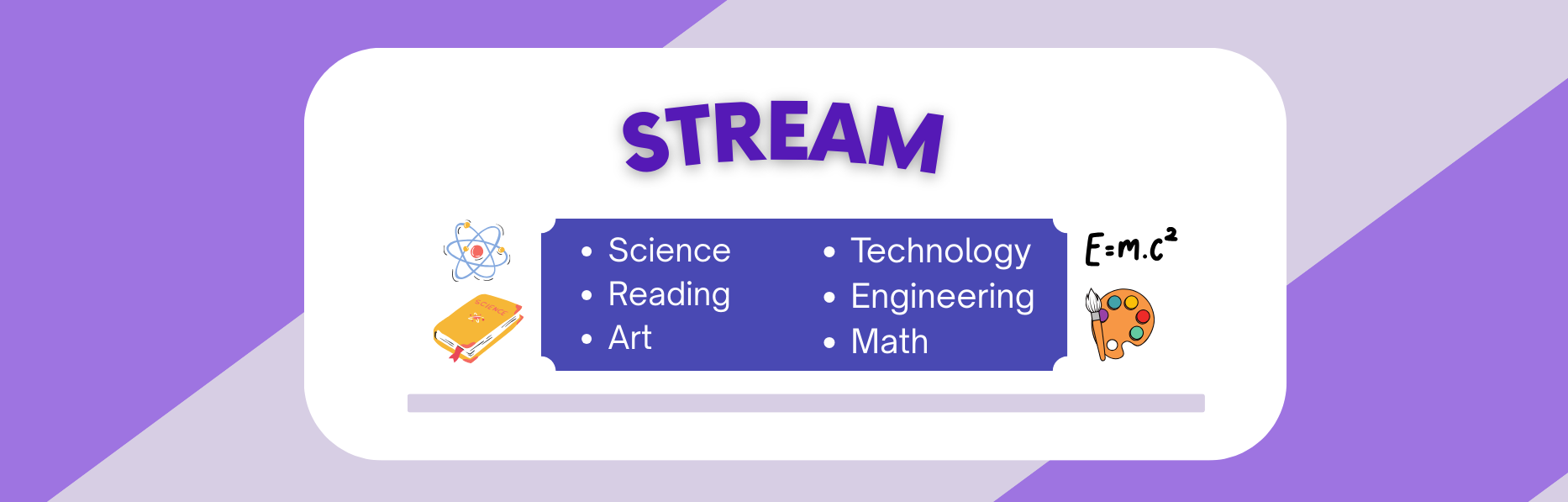
Let’s start with a basic question—what is STREAM education? STREAM is an acronym that represents Science, Technology, Reading, Engineering, Arts, and Mathematics. Every subject has its own importance. When all these subjects are combined, learning becomes a complete and balanced process.
If you have explored STEM vs STEAM vs STREAM, you will notice that STREAM further strengthens learning by adding reading and writing to the framework.
So, Why STREAM education is important? STREAM education is important because, in real life, subjects are not separated as they are in school. A simple assignment can involve math, research, design, and creativity simultaneously.
The STREAM approach to education helps children become confident and independent thinkers. It keeps children curious about exploring new ideas.
Core Components of STREAM Education
STREAM education combines different subjects into a connected learning experience. Let’s look at these modern education methods in detail.
➢ Science in STREAM
Science in STREAM education helps students see how things work in real life. It moves beyond textbooks and makes learning active and hands-on.
Students perform simple experiments to understand ideas better. They grow plants, mix materials, and observe small changes carefully. By watching results and discussing them, they learn why something happens in early science education.
If an experiment fails, they adjust and try again. Over time, they begin to understand patterns and cause and effect. Science and technology education become exciting because they discover answers through their own experiences.
➢ Technology in STREAM
Technology is the application of science to develop tools and systems that can solve practical problems. Technology is not only about computers and mobile phones. Other examples of technology include simple tools such as wheels, levers, ramps, pulleys, scissors, and magnifying glasses.
As children engage with these tools, they begin to develop an understanding of how things work. They learn about cause and effect as they experiment with the tools and observe the outcomes.
Acquiring this knowledge at a young age provides a solid foundation for basic knowledge. It also strengthens digital literacy for students, helping them understand and use modern tools responsibly and effectively.
➢ Reading in STREAM
The R in STREAM represents reading, and it is an extremely effective aspect of learning in the modern age. Reading is not confined to the English language class. It is an activity that helps students in all subjects and enables them to comprehend concepts more clearly.
When children learn effective reading skills, they are able to follow directions, learn new concepts quickly, and think critically about what they are learning. In STREAM classes, reading is an activity that is seamlessly integrated with science, technology, and engineering.
Children can read short science pieces, look at diagrams, or read simple technical descriptions to learn how something works. Reading increases vocabulary and helps children communicate more effectively. This continuous practice plays an important role in overall literacy development, supporting learning across every subject.
➢ Engineering in STREAM
Engineering is all about creating solutions for real-world problems. It involves the use of math, science, and technology to design and develop useful products and systems that improve life.
Children exhibit natural tendencies toward engineering skills. When they build with blocks, construct small forts, or create toy tracks, they are learning about how things fit together. They are experimenting, trying out their designs, and determining what works well. Engineering skills for students are teaching them how to solve problems by design.
Children are developing valuable skills such as logical thinking, spatial reasoning, and creativity through these activities. These skills provide a great foundation for learning and can even prepare them for a career in engineering.
➢ Arts in STREAM
Arts bring creativity in education and imagination to learning. This includes drawing, painting, music, drama, and design. Arts allow students to express their ideas in a creative way. In STREAM projects, art can be used to create posters, make models, or visually express ideas.
Creativity improves problem-solving skills because students think differently. Arts integration in education also enhances emotional expression and confidence. Children learn to express their ideas without fear.
Adding arts to learning maintains a balance in learning. This enhances both logic and imagination.
➢ Mathematics in STREAM
Mathematics learning skills are the study of numbers, shapes, and measures. It is the way we understand how things are connected and how the world works. Math skills include things like recognizing patterns, counting, comparing sizes, measuring, and understanding space.
Learning math skills in early childhood is a great way to give kids a strong foundation in math. Kids learn best through simple, everyday activities. Activities like building with blocks, playing kitchen games, or just playing outside help kids learn naturally.
By encouraging these simple activities, you can help kids feel confident around numbers. Learning math and science becomes much simpler when kids have these skills.
How to Implement STREAM Education in Schools?
STREAM works best when learning feels connected, practical, and meaningful. Let’s look at the steps to implement STREAM education in schools.
➢ Combine Subjects Through Integrated Projects
- Plan projects that mix science, math, reading, engineering, technology, and art.
- Let students design, build, measure, and explain their ideas in one activity.
- Help them see how subjects connect in real life.
➢ Encourage Active and Hands-On Learning
- Replace long lectures with experiments, models, and creative tasks.
- Allow students to test ideas and learn by doing.
- Make lessons more practical and engaging.
➢ Follow a Clear Problem-Solving Process
- Teach students to ask questions before jumping to answers.
- Guide them to research, design, test, and improve their solutions.
- Show that mistakes are part of learning and growth.
➢ Support and Train Teachers Regularly
- Provide workshops on project-based learning methods.
- Help teachers plan lessons that connect multiple subjects.
- Encourage collaboration among teachers for better results.
➢ Create Spaces for Exploration and Creativity
- Set up maker corners with simple tools and materials.
- Include art supplies, building blocks, and basic tech kits.
- Give students space to explore ideas freely.
➢ Connect Learning to Real-World Problems
- Choose projects based on real issues like the environment or community needs.
- Make lessons meaningful and relevant to daily life.
- Help students see how their ideas can make a difference.
Conclusion
Modern education is moving towards learning that has a sense of connection and purpose. STREAM is an important part of this new education because it brings science, technology, reading, engineering, art, and math together in one integrated way.
Rather than learning each subject in a separate way, students learn how ideas are connected and relate to each other.
What this looks like in a real classroom is building, testing, reading to understand, and designing creative solutions. The benefits of STREAM education for students are that they question, collaborate, and refine what they have learned through practice. Learning becomes active and meaningful.
Adding STREAM to modern education allows schools to develop students who are confident problem-solvers. It clearly shows how STREAM prepares students for the future by building adaptable thinkers who can apply knowledge in real-world situations.



 Jumpstart Journal
 R-A-R Activity
 Critical Thinking Exercise
 Picture Reflection Or Photo Caption
 Presentation
 Thematic Apperception Test (TAT)
 Flash Card
 Micro Learning
 Research Skills
 Workshop Report Presentation
 MCQ And Descriptive Questions
 Video Analysis Presentation
 Scenario Planning
 Problem Solving
 Trivia Quiz
 Flipped Classroom
 Generative Knowledge Interviewing
 Think-Pair-Share
 Fish Bowl Group Activity
 Jigsaw Method
 Simulation
 Peer Interview
 Role Play
 Debate
 Group Discussion
 Futurism And Trend Analysis
 Report Presentation
 Assignment Presentation
 Research Article Review Presentation
 Peer Teaching
 Industrial Visit Report Presentation
 Video Podcast
 Games
Games
 Business Games
 Collaborative Project
 Team Building
 Role Reversal
 Leadership Activity
 Pitch Deck
 Case Analysis Presentation


 Learner
 Mentor
 Organisation
 Learner
 Mentor
 Organisation