13 January 2026
Types of Evaluation in Education: Right Method to Measure Student Growth
Learning won’t stop after the lesson is over. It is essential for teachers to recognize what knowledge students grasp, apply, and retain after learning. This is where evaluation becomes important.
Evaluation helps in monitoring progress, making decisions about instruction, and facilitating growth for students. When used wisely, it becomes a tool for improvement, not pressure. Different learners need different ways to show progress.
This blog explains the major types of evaluation in education and how choosing the right method can support better learning outcomes for students at every stage.
Let’s understand it in detail.
Understanding Evaluation in Education
Evaluation is a systematic approach to assessing the outcome of learning over a period of time. It concentrates on what learners have achieved, as well as how learning objectives are met.
The process of evaluation plays a crucial part in decision-making, whether it is at a teaching institution or learner level. Evaluation works best when learning follows structured learning frameworks. Clear outlines help teachers connect objectives with outcomes and allow students to see how each topic fits into the bigger picture.
Many people get confused between assessment and evaluation. To differentiate between assessment and evaluation, assessment checks learning during the process, while evaluation looks at results after learning milestones.
Clear evaluation brings purpose and direction to education.
Why Student Evaluation Matters for Learning Growth?
Evaluation in education plays a strong role in shaping learning experiences. It supports both teaching and learning when done with care. Let’s see why it matters for learning growth.
1. Tracks Progress Clearly
Evaluation indicates the extent of progress made in learning. It prevents the brain from being confused for a long time.
2. Guides Teaching Choices
Educators utilize the results to adjust the pace, content, and methods. This makes the teaching and learning efficient.
3. Builds Student Awareness
Students identify their strengths and areas requiring improvement. It enables them to develop ownership of learning.
Major Types of Evaluation in Education Explained
Learning happens in stages, so evaluation must match each stage. Understanding the types of evaluation in education helps teachers choose methods that support learning instead of limiting it.
Let’s look at the types of evaluation in detail.
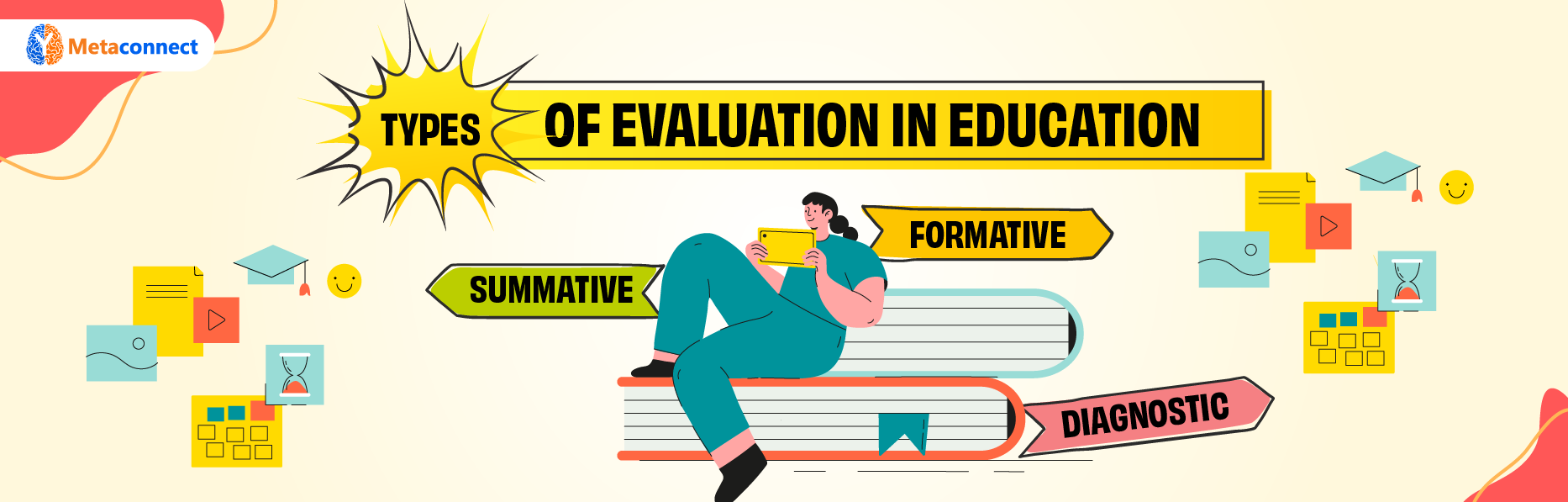
1. Placement Evaluation
Placement evaluation occurs before any teaching can be undertaken. Placement evaluation assists the teacher in knowing the amount of knowledge the students possess at the start of the lesson. This is significant since the students are protected from feeling lost and bored. A good start sets the foundation for effective learning.
2. Formative Evaluation
Formative evaluation is done during the process of learning. It involves class questions, quiz questions, homework assignments, peer review, and teacher observations. The main aim of formative evaluation is improvement rather than obtaining grades. becomes more effective when teachers focus on breaking information into measurable segments. Smaller learning units make it easier to check understanding and give timely feedback.
3. Summative Evaluation
Summative evaluation is done after the unit or term, or at the close of the course. Examples of summative evaluation include examinations, final assignments, or tests at the completion of the term. Summative evaluation provides a clear picture of overall achievement and is often used for reports and certifications.
4. Diagnostic Evaluation
Diagnostic evaluation assesses learning difficulties. With it, the teacher can determine why a particular student is finding a certain subject challenging. It also points to gaps in understanding and levels of skills. It is strongly supported by teacher-led demonstration and explanation. When teachers model their thinking aloud, students can identify where their own understanding is.
Together, these represent different forms of evaluation used to support learning fairly and effectively.
Choosing the Right Evaluation Method for Student Success
Choosing the right evaluation method depends on learning goals, student age, and subject needs. No single method works in every situation.
Placement tools help at the start, while formative checks support learning during lessons. Summative methods suit final outcomes. A balanced mix reduces pressure and improves understanding. Clear criteria and timely feedback make evaluation meaningful.
When teachers align goals with suitable methods of evaluation in education, learning becomes focused and purposeful.
How Smart Evaluation Supports Personalized Learning on YMetaconnect?
YMetaconnect uses evaluation to support growth rather than comparison. Learning progress is tracked through reflection, feedback, and skill development.
Tools like R-A-R (Review, Action, Reflection) help learners think about what they learned, how they applied it, and what to improve next.
SIMD supports goal setting and self-monitoring. This approach uses modern evaluation techniques to guide learners step by step. Mentors gain insights to support learners better.
With YMetaconnect, evaluation becomes a learning companion, not a judgment tool.
Conclusion
Evaluation influences the way learning is perceived and developed. When teachers are acquainted with the different types of evaluation, they are able to support the learners effectively. The appropriate approach develops confidence and helps achieve stable progress.
Effective evaluation will occur when it becomes progress-oriented, rather than pressure-oriented. When planned and reflective approaches to evaluation are used, learning itself will become deeper and more meaningful.
Effective evaluation enables students to move ahead with confidence.



 Jumpstart Journal
 R-A-R Activity
 Critical Thinking Exercise
 Picture Reflection Or Photo Caption
 Presentation
 Thematic Apperception Test (TAT)
 Flash Card
 Micro Learning
 Research Skills
 Workshop Report Presentation
 MCQ And Descriptive Questions
 Video Analysis Presentation
 Scenario Planning
 Problem Solving
 Trivia Quiz
 Flipped Classroom
 Generative Knowledge Interviewing
 Think-Pair-Share
 Fish Bowl Group Activity
 Jigsaw Method
 Simulation
 Peer Interview
 Role Play
 Debate
 Group Discussion
 Futurism And Trend Analysis
 Report Presentation
 Assignment Presentation
 Research Article Review Presentation
 Peer Teaching
 Industrial Visit Report Presentation
 Video Podcast
 Games
Games
 Business Games
 Collaborative Project
 Team Building
 Role Reversal
 Leadership Activity
 Pitch Deck
 Case Analysis Presentation


 Learner
 Mentor
 Organisation
 Learner
 Mentor
 Organisation